

The green apple dongle (24/44 FLAC) has been out for a while (since Christmas, 2009 I believe), so I'm interested to hear if anyone else has compared it with the the CD (16/44) version? I'm very happy with my copy, and its probably what started me on my quest for HD music, but I guess there's a debate whether it's *really* better.
-
- Mike
Main System:
B&W 802D, HTM2D, SCMS
Classé SSP-800, CA-2200, CA-5100 -
Well, that is an interesting question- I've been planning on getting one of those 24 bit dongles, but still haven't gotten around to it. Frankly, it probably depends on the noise floor of the original recordings and how well reverb tails and other low level stuff is handled on the 16 bit version versus 24 bit. If you did a 16 bit version with mBit dithering, I suspect you wouldn't hear any difference. If they didn't do any intelligent dithering, then perhaps you would. Then, too, it all depend on your DAC. Even many so called high performance DAC's don't have more than an 18 bit noise floor, and I've seen ones billed as high resolution that hardly get 16 bits on high res data-
For example, look at the swept noise floor with 16 bit and 24 bit data for the Playback Designs MPS-5 SACD/CD player.

Fig.3 Playback Designs MPS-5, 1/3-octave spectrum with noise and spuriae of dithered 1kHz tone at –90dBFS with: 16-bit data (top), 24-bit data (middle at 2kHz), DSD data (top trace at 20kHz). (Right channel dashed.)
To understand just how poor this is, here is the same sort of test, also by Stereophile, for the NAD M51 DAC.
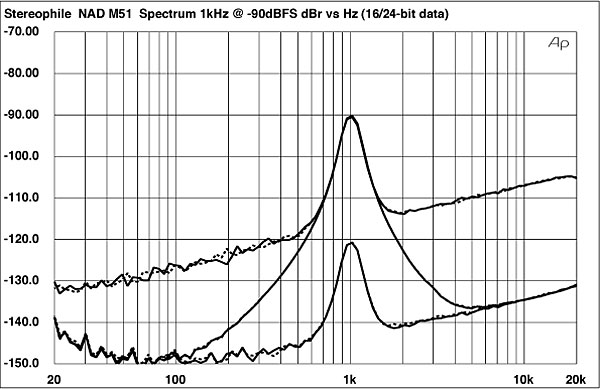
Fig.3 NAD M51, 1/3-octave spectrum with noise and spuriae of dithered 1kHz tone at –90dBFS, with: 16-bit data (top), 24-bit data (middle), dithered 1kHz tone at –120dBFS with 24-bit data (bottom) (right channel dashed).
Sooo, in summary, I'd say, "it all depends...." but in general, I expect they didn't do the 24 bit thing just as a marketing spoof, so I'd say hold on to what you've got...the AudioWorx
Natalie P
M8ta
Modula Neo DCC
Modula MT XE
Modula Xtreme
Isiris
Wavecor Ardent
SMJ
Minerva Monitor
Calliope
Ardent D
In Development...
Isiris Mk II updates- in final test stage!
Obi-Wan
Saint-Saëns Symphonique/AKA SMJ-40
Modula PWB
Calliope CC Supreme
Natalie P Ultra
Natalie P Supreme
Janus BP1 Sub
Resistance is not futile, it is Volts divided by Amperes...
Just ask Mr. Ohm....

-
 So I finally called comcast and got the HDcable package.
With the new "cable box" connected im getting a quite loud hiss through my amps. I will try and be as brief to the point as I can.
Two bryston amps plugged into the wall for the mains
Monster power... -

Exciting huh?
Actually, it's surrounded by one of these:
Now, I know, you folks in the SACD camp are not to happy with me about now. But this is my moment, so hear me out!
Quote from Rega's website:
... -
Out of this world! (Jupiter) ha!
There was one technical snafus due to shipping. I mentioned it in the other thread, that the display color cover slid down on one side. The center ring of the flip top cover is loose, and as it turns out is supposed to be, because the chrome ring on the... -
 Using white noise to aim and adjust speakers AIMING and "LEARNING" SPEAKERS Here is a method for "aiming" ...25 July 2010, 16:28 Sunday
 -
 I posted this before, but I think the details might have dissuaded anyone from attempting it. Here's a much easier version that works just as well. Turns out that one flute works as well as two since the guide keeps it so stable. That really simplifies the build.
I was getting something...
Comment