

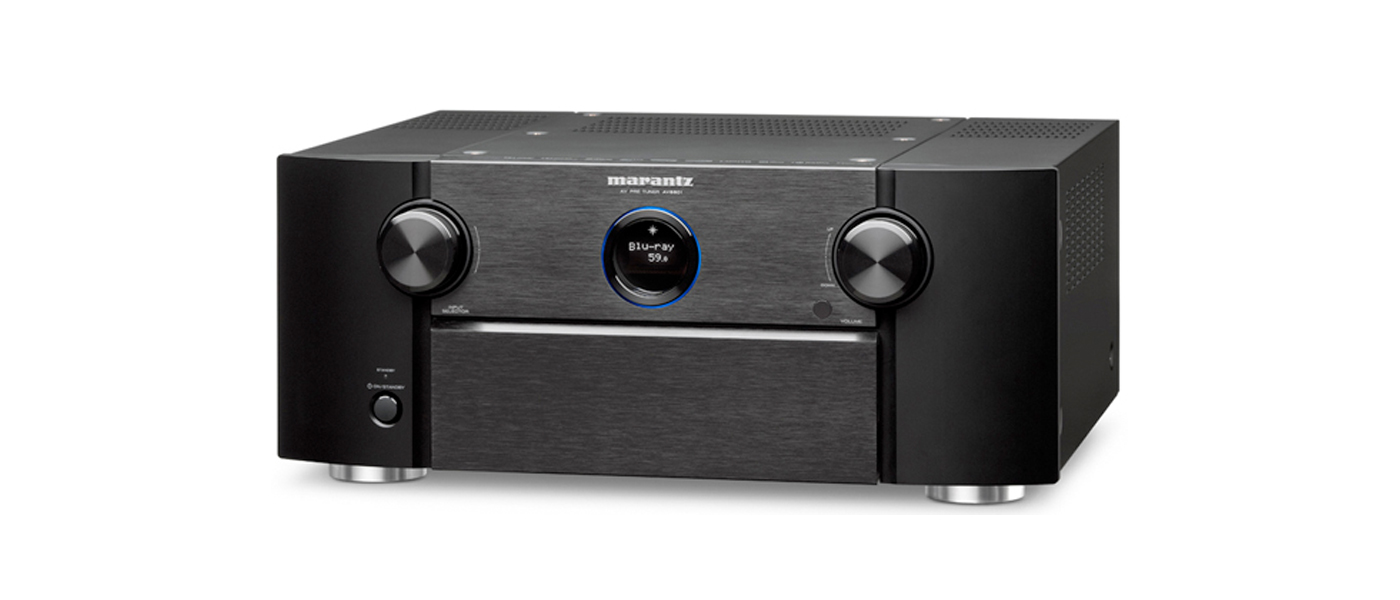
When I got the email with Trond-Erik's new Pro-Pro, something about that rang a bell. The bell was related to an AV Forums post by a guy with high sensitivity speakers comparing the Benchmark AHB2 amplifier and the M22 and some other amplifiers. One of his bugaboos was output noise, and noise that could be heard through the horn tweeter with the system just siting there and the volume turned all the way down. It seems to turn out that there were some design decisions made in the 8801 that affect this, which have been fixed in the 8802. This impacts the overall processor noise floor, which could affect decisions about how far to take the design of the Class D system board in Trond-Erik's case.
Also, the HDAM audio module design between the 8801 and 8802 is quite different. (the 8802 was designed after the merger of Denon and Marantz).
I'm going to include a few pages I captured from the Secrets of Home Theater and High Fidelity web site. Of course, we should keep in mind that this is an HT PrePro, not a high end stereo component, and by the former's market expectations, it's a fairly well designed piece of gear. I'm bringing all this stuff up, because in my own system and listening tests, I have different gear and different expectations. And system component matching for performance/cost considerations should be kept in mind.
For preamp measurements, their main test point was 2VRMS, as this is the signal level needed to give rated output for most power amplifiers.
The portion re David Rich's comments about the pro-pro versus Marantz Technical Product manager:

What this boils down to, is that they used a gain of 2 stage in the volume control prior to the output drivers, and this raises the noise floor by 6 dB compared to running them in unity gain. Note Paul Belanger's comment defending the specific volume control IC used (same type as used in some entry level Yamaha receivers) His points mainly lie in the area of cost effective and balanced engineering- use that which is just good enough, and that no one part will dominate or make for problems.
Now, for me, this is a sensitive point in particular, because I have done a bit of contract work for a 3rd party company in the high end HiFi area, and one of the things we concluded is that most of the HT processor volume control IC's don't measure all that well, and sound worse. Mind you, 0.002% THD at 1kHz would be respectable performance in the mid to late 70's for a preamp module. OTOH, at that time I was doing power amplifiers that did that well at full output, which is much harder, and preamp modules at less than 0.001- I just could measure how much less at that time. I figured if they didn't budge the residual output on the analyzer, that was good enough.
This is NOT to say that this won't be a nice unit for home theater- expectations and requirements are different, as regards retrieval of low level detail, and the overall source quality. There is a lot of nice HT functionality in the 8801.
OTOH, assuming there are some significant sonic differences between two amplifiers, one measuring about 0.002%, the other about 0.0004% or so, this isn't the front end that you'll likely hear that difference with.
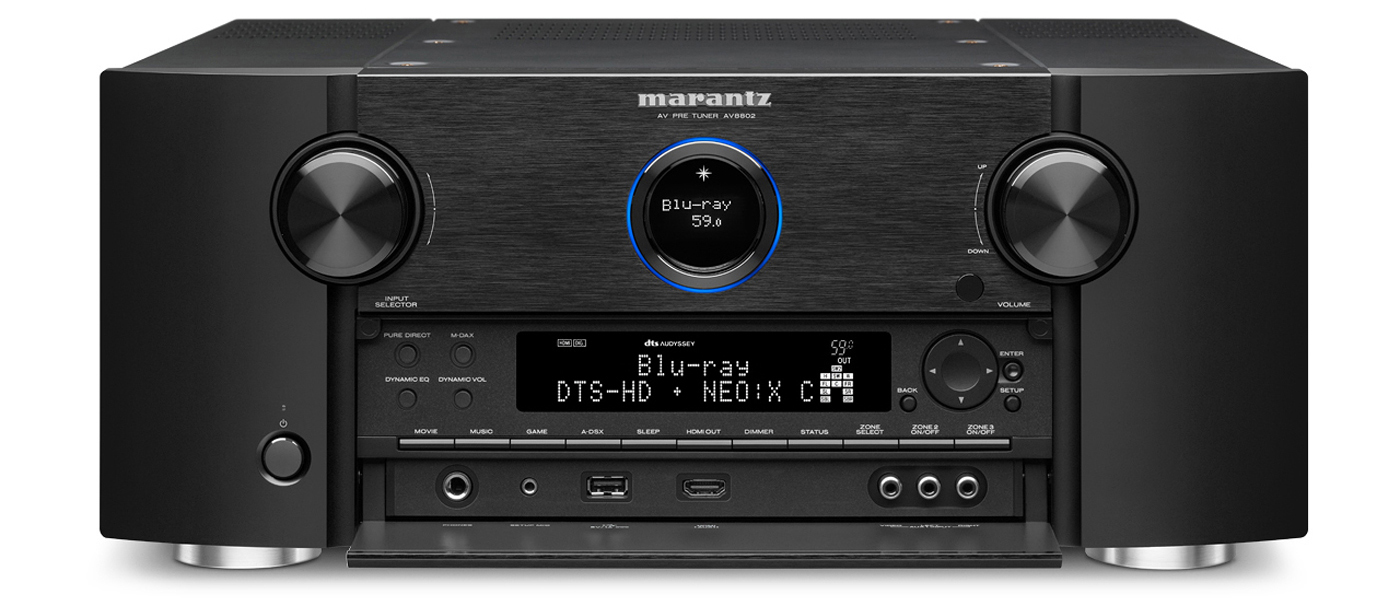
Here's the review on the 8802.
Very solid performance for a Pre-Pro, and some improvements, but measured performance still doesn't blow me away.
The output buffers are powered by +/- 12V supplies; the rest of the internal audio circuitry is powered by +/- 7V.
Odd choice to me, but it may be typical for the industry, as it's only dealing with the output of onboard digital processors? But it does have implications. The buffers are actual discrete output amplifiers in this version.
The implications come in with the gain structure. If the buffers are 0 dB gain, what is the max gain of the volume control processor? With that circuit running on +/- 7V rails, the actual Pk-Pk excursion is no more than +/- 5V in all likelihood, which is about 3.5 VRMS. So running with amplifiers that require higher input voltage won't work well.
OTOH, my Cambridge Audio Preamp can do 8VRMS output, and an AURALiC Taurus Pre will do 12V RMS.
Another way this is significant is the range of optimum operation for the analog circuitry; while op amps typically clip about 2V below the rails, the most linear range of operation may be another 2-3V or more below that, even for high performance types.
You can get an idea of this behavior by comparing these two distortion curves for different rail voltages for the LME49724, a very high performance part which is what I would recommend for the "standard" version using the Hypex style front end with dual op amps in an instrumentation configuration. This is available in a similar dual configuration that would drop in to the OEM adapter board.

Also, the HDAM audio module design between the 8801 and 8802 is quite different. (the 8802 was designed after the merger of Denon and Marantz).
I'm going to include a few pages I captured from the Secrets of Home Theater and High Fidelity web site. Of course, we should keep in mind that this is an HT PrePro, not a high end stereo component, and by the former's market expectations, it's a fairly well designed piece of gear. I'm bringing all this stuff up, because in my own system and listening tests, I have different gear and different expectations. And system component matching for performance/cost considerations should be kept in mind.
For preamp measurements, their main test point was 2VRMS, as this is the signal level needed to give rated output for most power amplifiers.
The portion re David Rich's comments about the pro-pro versus Marantz Technical Product manager:
What this boils down to, is that they used a gain of 2 stage in the volume control prior to the output drivers, and this raises the noise floor by 6 dB compared to running them in unity gain. Note Paul Belanger's comment defending the specific volume control IC used (same type as used in some entry level Yamaha receivers) His points mainly lie in the area of cost effective and balanced engineering- use that which is just good enough, and that no one part will dominate or make for problems.
Now, for me, this is a sensitive point in particular, because I have done a bit of contract work for a 3rd party company in the high end HiFi area, and one of the things we concluded is that most of the HT processor volume control IC's don't measure all that well, and sound worse. Mind you, 0.002% THD at 1kHz would be respectable performance in the mid to late 70's for a preamp module. OTOH, at that time I was doing power amplifiers that did that well at full output, which is much harder, and preamp modules at less than 0.001- I just could measure how much less at that time. I figured if they didn't budge the residual output on the analyzer, that was good enough.
This is NOT to say that this won't be a nice unit for home theater- expectations and requirements are different, as regards retrieval of low level detail, and the overall source quality. There is a lot of nice HT functionality in the 8801.
OTOH, assuming there are some significant sonic differences between two amplifiers, one measuring about 0.002%, the other about 0.0004% or so, this isn't the front end that you'll likely hear that difference with.
Here's the review on the 8802.
Very solid performance for a Pre-Pro, and some improvements, but measured performance still doesn't blow me away.
The output buffers are powered by +/- 12V supplies; the rest of the internal audio circuitry is powered by +/- 7V.
Odd choice to me, but it may be typical for the industry, as it's only dealing with the output of onboard digital processors? But it does have implications. The buffers are actual discrete output amplifiers in this version.
The implications come in with the gain structure. If the buffers are 0 dB gain, what is the max gain of the volume control processor? With that circuit running on +/- 7V rails, the actual Pk-Pk excursion is no more than +/- 5V in all likelihood, which is about 3.5 VRMS. So running with amplifiers that require higher input voltage won't work well.
OTOH, my Cambridge Audio Preamp can do 8VRMS output, and an AURALiC Taurus Pre will do 12V RMS.
Another way this is significant is the range of optimum operation for the analog circuitry; while op amps typically clip about 2V below the rails, the most linear range of operation may be another 2-3V or more below that, even for high performance types.
You can get an idea of this behavior by comparing these two distortion curves for different rail voltages for the LME49724, a very high performance part which is what I would recommend for the "standard" version using the Hypex style front end with dual op amps in an instrumentation configuration. This is available in a similar dual configuration that would drop in to the OEM adapter board.
Marantz improved the design of the AV8802 in several key areas. The HDAM (Hyper Dynamic Amplifier Module) circuitry is upgraded to HDAM-SA2, which Marantz also used to improve the quality of the XLR outputs and lower the overall noise floor.A Cirrus Logic CS2100 clock generator was used to reduce jitter. The DAC was upgraded to an AKM 4490, which supports native DSD. Marantz also borrowed design concepts for the transformer in the AV8802 from the Marantz PM-11S3 reference stereo integrated amplifier and used four custom Nichicon 10,000μF capacitors in the AV8802 to ensure adequate power reserve.
From an internal perspective, Secrets’ Dr. David Rich offered this analysis on the design of the AV8802:
“The AV8802 is similar in design to the AV8801 in the analog path but a significant improvement has been made to the output circuitry. The output circuitry is now a pair of fully discrete, fully complementary, current mode opamps per channel. The first discrete opamp is wired as a unity gain buffer (10 transistors) and interfaces between the Renesas R2A15220FP LSI and the RCA output jack. The output also goes to the positive output pin of the XLR (pin 2).
The other discrete opamp is wired as a unity gain inverter (14 transistors) and is connected from the output of the non-inverting buffer to the negative output pin of the XLR (pin 3). Current draw for the 26 discrete buffers is +/- 320mA.
The buffers are powered by a +/- 12V DC power supply. The unregulated rails for the discrete output buffers are produced by a separate transformer winding which would have had the function of supplying the power amp in an AVR. For the AVR the transformer winding would be at a much higher voltage.
RCA and XLR output anti-pop on power up muting function is performed by relays.
The signal to noise ratio of the AV8802 is improved over the AV8801 with the output stage redesign. The AV8801 output stage had a gain of two. The AV8802 output stage is now unity gain. The noise from the volume control block, which is the dominate noise source in the analog signal path, is not increased by the output stage in the AV8802. The signal at the output of the DAC, which is before the volume control, is doubled in the AV8802 to compensate for the gain reduction at the output.
The Analog Devices ADSP21487 DSP chips are used in the AV8802. Each ADSP21487 performs 2700 32 bit MLFOPs (Mega Floating-Point Operations per Second). MFLOP is a figure of merit for DSP performance.
Four DSPs are used in used in the AV8802. It is easy to pipeline DSPs in a Surround Sound Processor since different functions are assigned to different DSP. For example, ATMOS decoding could occur in one DSP, room correction in another, bass management in a 3rd and Dolby® TrueHD decode in the 4th.
The ADSP21487 has an on board Asynchronous Sample Rate Converters (8 channels). In the measurements, we see the fundamental has less FM sideband indicative of the reduction of jitter on the HDMI clock. Unfortunately, we see several spurs uncorrelated to the fundamental in these spectra. This may indicate some correlated jitter between the clocks of the 4 DSPs but this is just one of several possible explanations.
The number of DSPs used in the AV8802 and the computational power of each is the result of the addition of ATMOS decoding and the need to process 11.2 channels instead of the standard 7.1.
The DAC is changed from a TI PCM1795 in the AV8801 to the AKM AK4490 in the AV8802. The worst case signal to noise declines from 120dB to 115dB but worst case distortion improves from 0.001% to 0.0006%. The distortion measurements are for a full scale signal at a data rate of 44.1k samples /sec. The AKM AK4490 supports DSD. The schematic shows data signal marked DSD coming from both chips associated with HDMI and USB.
The ADC remains the AKM AK5358B.
A +/- 7V power supply is used for the analog audio circuits outside the output buffer. This supply is derived from its own transformer winding. This supply powers the Renesas R2A15220FP LSI chips (two are required given the additional height channels), SSI opamps and other analog circuitry is at +/-7V. The DACs and ADC power supply is down regulated from the +7V supply. The fine line analog CMOS technology in the DACs and ADC is limited to a 5V supply.
All digital circuits are supplied from a large 5V digital switching power supply. These are locally down regulated by 11 switching DC to DC converters to the sub-blocks of this very complex piece of electronics. All the digital chips dissipate approximately 40 Watts which makes high efficiency switching power supplies mandatory. “
From an internal perspective, Secrets’ Dr. David Rich offered this analysis on the design of the AV8802:
“The AV8802 is similar in design to the AV8801 in the analog path but a significant improvement has been made to the output circuitry. The output circuitry is now a pair of fully discrete, fully complementary, current mode opamps per channel. The first discrete opamp is wired as a unity gain buffer (10 transistors) and interfaces between the Renesas R2A15220FP LSI and the RCA output jack. The output also goes to the positive output pin of the XLR (pin 2).
The other discrete opamp is wired as a unity gain inverter (14 transistors) and is connected from the output of the non-inverting buffer to the negative output pin of the XLR (pin 3). Current draw for the 26 discrete buffers is +/- 320mA.
The buffers are powered by a +/- 12V DC power supply. The unregulated rails for the discrete output buffers are produced by a separate transformer winding which would have had the function of supplying the power amp in an AVR. For the AVR the transformer winding would be at a much higher voltage.
RCA and XLR output anti-pop on power up muting function is performed by relays.
The signal to noise ratio of the AV8802 is improved over the AV8801 with the output stage redesign. The AV8801 output stage had a gain of two. The AV8802 output stage is now unity gain. The noise from the volume control block, which is the dominate noise source in the analog signal path, is not increased by the output stage in the AV8802. The signal at the output of the DAC, which is before the volume control, is doubled in the AV8802 to compensate for the gain reduction at the output.
The Analog Devices ADSP21487 DSP chips are used in the AV8802. Each ADSP21487 performs 2700 32 bit MLFOPs (Mega Floating-Point Operations per Second). MFLOP is a figure of merit for DSP performance.
Four DSPs are used in used in the AV8802. It is easy to pipeline DSPs in a Surround Sound Processor since different functions are assigned to different DSP. For example, ATMOS decoding could occur in one DSP, room correction in another, bass management in a 3rd and Dolby® TrueHD decode in the 4th.
The ADSP21487 has an on board Asynchronous Sample Rate Converters (8 channels). In the measurements, we see the fundamental has less FM sideband indicative of the reduction of jitter on the HDMI clock. Unfortunately, we see several spurs uncorrelated to the fundamental in these spectra. This may indicate some correlated jitter between the clocks of the 4 DSPs but this is just one of several possible explanations.
The number of DSPs used in the AV8802 and the computational power of each is the result of the addition of ATMOS decoding and the need to process 11.2 channels instead of the standard 7.1.
The DAC is changed from a TI PCM1795 in the AV8801 to the AKM AK4490 in the AV8802. The worst case signal to noise declines from 120dB to 115dB but worst case distortion improves from 0.001% to 0.0006%. The distortion measurements are for a full scale signal at a data rate of 44.1k samples /sec. The AKM AK4490 supports DSD. The schematic shows data signal marked DSD coming from both chips associated with HDMI and USB.
The ADC remains the AKM AK5358B.
A +/- 7V power supply is used for the analog audio circuits outside the output buffer. This supply is derived from its own transformer winding. This supply powers the Renesas R2A15220FP LSI chips (two are required given the additional height channels), SSI opamps and other analog circuitry is at +/-7V. The DACs and ADC power supply is down regulated from the +7V supply. The fine line analog CMOS technology in the DACs and ADC is limited to a 5V supply.
All digital circuits are supplied from a large 5V digital switching power supply. These are locally down regulated by 11 switching DC to DC converters to the sub-blocks of this very complex piece of electronics. All the digital chips dissipate approximately 40 Watts which makes high efficiency switching power supplies mandatory. “


 ops:
ops:


Comment