

Do you remember what your first computer was?
As best I can remember in the early 90's we purchased our first computer...
It was a 386DX (or SX) with I believe 4 or 8MB of RAM and maybe a 200MB HD... with a 13 or 14" monitor. I can't remember exactly myself but I know it was puny compared to todays computers... and it cost us $1400... and we had no clue as to what to do with it.
Here's sample of some of the first major computers...

The public got its first glimpse of the ENIAC, a machine built by John Mauchly and J. Presper Eckert that improved by 1,000 times on the speed of its contemporaries.Start of project: 1943
Completed: 1946
Programmed: plug board and switches
Speed: 5,000 operations per second
Input/output: cards, lights, switches, plugs
Floor space: 1,000 square feet

The UNIVAC I delivered to the U.S. Census Bureau was the first commercial computer to attract widespread public attention. Although manufactured by Remington Rand, the machine often was mistakenly referred to as the "IBM UNIVAC." Remington Rand eventually sold 46 machines at more than $1 million each.
Speed: 1,905 operations per second
Input/output: magnetic tape, unityper, printer
Memory size: 1,000 12-digit words in delay lines
Memory type: delay lines, magnetic tape
Technology: serial vacuum tubes, delay lines, magnetic tape
Floor space: 943 cubic feet
Cost: F.O.B. factory $750,000 plus $185,000 for a high speed printer

Data General Corp., started by a group of engineers that had left Digital Equipment Corp., introduced the Nova, with 32 kilobytes of memory, for $8,000.

The Kenbak-1, the first personal computer, advertised for $750 in Scientific American. Designed by John V. Blankenbaker using standard medium-scale and small-scale integrated circuits, the Kenbak-1 relied on switches for input and lights for output from its 256-byte memory. In 1973, after selling only 40 machines, Kenbak Corp. closed its doors.

Scelbi advertised its 8H computer, the first commercially advertised U.S. computer based on a microprocessor, Intel´s 8008. Scelbi aimed the 8H, available both in kit form and fully assembled, at scientific, electronic, and biological applications. It had 4 kilobytes of internal memory and a cassette tape, with both teletype and oscilloscope interfaces. In 1975, Scelbi introduced the 8B version with 16 kilobytes of memory for the business market. The company sold about 200 machines, losing $500 per unit.

In the first month after its release, Tandy Radio Shack´s first desktop computer — the TRS-80 — sold 10,000 units, well more than the company´s projected sales of 3,000 units for one year. Priced at $599.95, the machine included a Z80 based microprocessor, a video display, 4 kilobytes of memory, BASIC, cassette storage, and easy-to-understand manuals that assumed no prior knowledge on the part of the consumer.

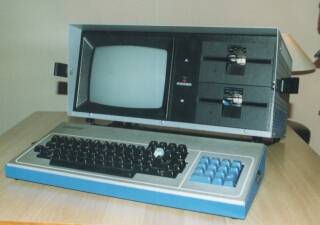
Adam Osborne completed the first portable computer, the Osborne I, which weighed 24 pounds and cost $1,795. The price made the machine especially attractive, as it included software worth about $1,500. The machine featured a 5-inch display, 64 kilobytes of memory, a modem, and two 5 1/4-inch floppy disk drives.
As best I can remember in the early 90's we purchased our first computer...
It was a 386DX (or SX) with I believe 4 or 8MB of RAM and maybe a 200MB HD... with a 13 or 14" monitor. I can't remember exactly myself but I know it was puny compared to todays computers... and it cost us $1400... and we had no clue as to what to do with it.
Here's sample of some of the first major computers...
The public got its first glimpse of the ENIAC, a machine built by John Mauchly and J. Presper Eckert that improved by 1,000 times on the speed of its contemporaries.Start of project: 1943
Completed: 1946
Programmed: plug board and switches
Speed: 5,000 operations per second
Input/output: cards, lights, switches, plugs
Floor space: 1,000 square feet
The UNIVAC I delivered to the U.S. Census Bureau was the first commercial computer to attract widespread public attention. Although manufactured by Remington Rand, the machine often was mistakenly referred to as the "IBM UNIVAC." Remington Rand eventually sold 46 machines at more than $1 million each.
Speed: 1,905 operations per second
Input/output: magnetic tape, unityper, printer
Memory size: 1,000 12-digit words in delay lines
Memory type: delay lines, magnetic tape
Technology: serial vacuum tubes, delay lines, magnetic tape
Floor space: 943 cubic feet
Cost: F.O.B. factory $750,000 plus $185,000 for a high speed printer
Data General Corp., started by a group of engineers that had left Digital Equipment Corp., introduced the Nova, with 32 kilobytes of memory, for $8,000.
The Kenbak-1, the first personal computer, advertised for $750 in Scientific American. Designed by John V. Blankenbaker using standard medium-scale and small-scale integrated circuits, the Kenbak-1 relied on switches for input and lights for output from its 256-byte memory. In 1973, after selling only 40 machines, Kenbak Corp. closed its doors.
Scelbi advertised its 8H computer, the first commercially advertised U.S. computer based on a microprocessor, Intel´s 8008. Scelbi aimed the 8H, available both in kit form and fully assembled, at scientific, electronic, and biological applications. It had 4 kilobytes of internal memory and a cassette tape, with both teletype and oscilloscope interfaces. In 1975, Scelbi introduced the 8B version with 16 kilobytes of memory for the business market. The company sold about 200 machines, losing $500 per unit.
In the first month after its release, Tandy Radio Shack´s first desktop computer — the TRS-80 — sold 10,000 units, well more than the company´s projected sales of 3,000 units for one year. Priced at $599.95, the machine included a Z80 based microprocessor, a video display, 4 kilobytes of memory, BASIC, cassette storage, and easy-to-understand manuals that assumed no prior knowledge on the part of the consumer.
Adam Osborne completed the first portable computer, the Osborne I, which weighed 24 pounds and cost $1,795. The price made the machine especially attractive, as it included software worth about $1,500. The machine featured a 5-inch display, 64 kilobytes of memory, a modem, and two 5 1/4-inch floppy disk drives.








Comment