RB 1090 vs RB 1092

Collapse
This topic is closed.
X
X
 
  • Time
  • Show
Clear All
new posts
  • Roteller
    Junior Member
    • Nov 2007
    • 28

    #1

    RB 1090 vs RB 1092

    Hi, I am looking for some advice on the differences between the two amps. I currently have an RB 1090 and love it to death, but I am becomming more and more curious about these new D class amps.

    How much of a difference would a person notice power wise with the extra 120 Watts per channel?

    How stable are these new amps with lower ohm loads on them. We all know how well the RB 1090 can handle this.

    Also I noticed the damping factor is much lower on the RB 1092(400), compared to the RB 1090(1000). How much of en effect would this have on speaker control?

    I would like to upgrade, but want to educate myself before making the big jump. Also it is quite the hike to my nearest dealer, so any insight on this subject, be it positive or negative would be greatly appreciated before heading to a dealer.

    Thanks.
    Last edited by Roteller; 04 June 2008, 15:42 Wednesday. Reason: Need to clarify something
  • gianni
    Senior Member
    • Nov 2002
    • 524

    #2
    Originally posted by Roteller
    Hi, I am looking for some advice on the differences between the two amps. I currently have an RB 1090 and love it to death, but I am becomming more and more curious about these new D class amps.

    How much of a difference would a person notice power wise with the extra 120 Watts per channel?

    How stable are these new amps with lower ohm loads on them. We all know how well the RB 1090 can handle this

    Also I noticed the damping factor is much lower on the RB 1092(400), compared to the RB 1090(1000). How much of en effect would this have on speaker control?

    I would like to upgrade, but want to educate myself before making the big jump. Also it is quite the hike to my nearest dealer, so any insight on this subject, be it positive or negative would be greatly appreciated before heading to a dealer.

    Thanks.

    Depends on speakers and room but in the vast majority of cases the extra power will make no difference.

    Rotel's class D amps track low impedance loads quite well - better than most traditional amps.

    A damping factor of 400 is more than adequate. Anything more just pads the specs and won't make much difference for most speakers. In fact, there are many good amps with factors under 400.

    While gaining a basic understanding is good, don't select your amps on specs alone. Take your time and do some comparative listening tests.

    Comment

    • Mig17
      Senior Member
      • Jan 2008
      • 169

      #3
      damping factor 1000 is needed for very big speakers like BW 802 or 801
      or Dynaauio Audience 82

      Comment

      • BassThatHz
        Senior Member
        • Jul 2006
        • 153

        #4
        Unless you need to save space, weight and electrical bill... I would say don't bother. Digital amps have some residual switching noise above 7khz... how much of that you hear really depends on your ears and speakers. ~1%THD above 16khz @ 100watts

        Comment

        • Ferres
          Senior Member
          • Jan 2007
          • 158

          #5
          I agree. If you already have an rb1090 and have no space/weight/electricity bill issues with it...

          Comment

          • gianni
            Senior Member
            • Nov 2002
            • 524

            #6
            Originally posted by Mig17
            damping factor 1000 is needed for very big speakers like BW 802 or 801
            or Dynaauio Audience 82

            Oh really? I guess that means that most of the Bryston line, Krell, Pass and other quality amplifiers are incapable of driving these B&W speakers.

            I would suggest you take another look at this topic. No sense in making statements that may not be accurate.

            Comment

            • Roteller
              Junior Member
              • Nov 2007
              • 28

              #7
              Thanks to all that responded, and if anyone else has any other input or information I would greatly appreciate it.

              Comment

              • Roteller
                Junior Member
                • Nov 2007
                • 28

                #8
                Originally posted by BassThatHz
                Unless you need to save space, weight and electrical bill... I would say don't bother. Digital amps have some residual switching noise above 7khz... how much of that you hear really depends on your ears and speakers. ~1%THD above 16khz @ 100watts
                So are you saying that these amps are not as clean as the RB 1090?

                Comment

                • mjb
                  Super Senior Member
                  • Mar 2005
                  • 1485

                  #9
                  Originally posted by BassThatHz
                  Unless you need to save space, weight and electrical bill... I would say don't bother. Digital amps have some residual switching noise above 7khz... how much of that you hear really depends on your ears and speakers. ~1%THD above 16khz @ 100watts
                  Can you qualify that?


                  Says on the data sheet:
                  1000W @ 0.01% THD+N, 100 Hz, 4Ω
                  1175W @ 1% THD+N, 1kHz, 4Ω

                  THD+N < 0.2%, 0.1W – 1100W, 4Ω

                  I agree the THD is a little higher than a linear amp, but I can't hear it. I don't think I can hear any "residual switching noise" either.

                  At the end of the day, either people like the Rotel D amps, or they don't (probably due to a pre-conceived prejudice). Personally, I'm more than happy with my RB-1092. The power is virtually bottomless, it tracks any load, runs cool, its light, and it takes up minimal room. Very high WAF factor!

                  If you're interested in a D amp, then try to listen to one (without prejudice) and let your ears decide.
                  - Mike

                  Main System:
                  B&W 802D, HTM2D, SCMS
                  Classé SSP-800, CA-2200, CA-5100

                  Comment

                  • Alaric
                    Ultra Senior Member
                    • Jan 2006
                    • 4151

                    #10
                    Having heard both , I vote for the RB1090. YMMV.
                    Lee

                    Marantz PM7200-RIP
                    Marantz PM-KI Pearl
                    Schiit Modi 3
                    Marantz CD5005
                    Paradigm Studio 60 v.3

                    Comment

                    • JRachwalski
                      Junior Member
                      • Jun 2008
                      • 29

                      #11
                      The Rotel Class D amps use Analog Controlled Oscillation Modulation rather than Digital. This helps to reduce audible switching noise. I have auditioned both the 1092 and 1085 - and neither have audible HF distortion, (the 1092 measured close to 1% above 5Khz at 300 watts).

                      My listening tests with the 1092 was done with B&W 804s.
                      My listening tests with the 1085 was done RAW Acoustics OB3 (Open baffle midrange and ribbon tweeters).

                      Measurments:
                      http://www.hometheaterhifi.com/ampli...plifier_3.html

                      Comment

                      • style
                        Super Senior Member
                        • Feb 2006
                        • 1562

                        #12
                        Hy,

                        I do not use anything when I have to choose between one or the other ...

                        I use "only" my ears! ops:

                        I had all two hours and now my set is RB1092 to front, RB1091 to center, RB1092 to rear.

                        I like very much the sound from the new D class.

                        Only point for RB1090 was XLR I/O but the Rotel pre/pro don't understand this
                        point.......

                        Omar

                        Comment

                        • miner
                          Senior Member
                          • Mar 2005
                          • 900

                          #13
                          I have compared the two; the owner of the RB-1090 and I both came to the same conclusion: RB-1092.

                          Comment

                          • BassThatHz
                            Senior Member
                            • Jul 2006
                            • 153

                            #14
                            http://www.hometheaterhifi.com/image...ct-reviews.gif

                            According to this image: 20v @ 4ohm's is 1% THD+N above 5khz
                            and >0.1THD+N above 3khz

                            I = V/R
                            P = I * V
                            So:
                            20 volts / 4 ohm = 5 amps
                            5 amps * 20 volts = 100 watts (or 50watts for 8ohm)

                            http://www.hometheaterhifi.com/image...ct-reviews.gif

                            At the 312 watt sweep:
                            The Min THD+N is ~0.018% and Max is 5% at 18-20khz

                            At the 496 watt sweep:
                            Min THD+N is 0.22% and Max is > 1% above 5khz
                            Between 11khz and 35khz ~2-11% THD+N

                            This isn't apples to apples, but the rb-1090 was measured at 4watts and never rose above 0.05% even when >20khz; and at >407W it clips.

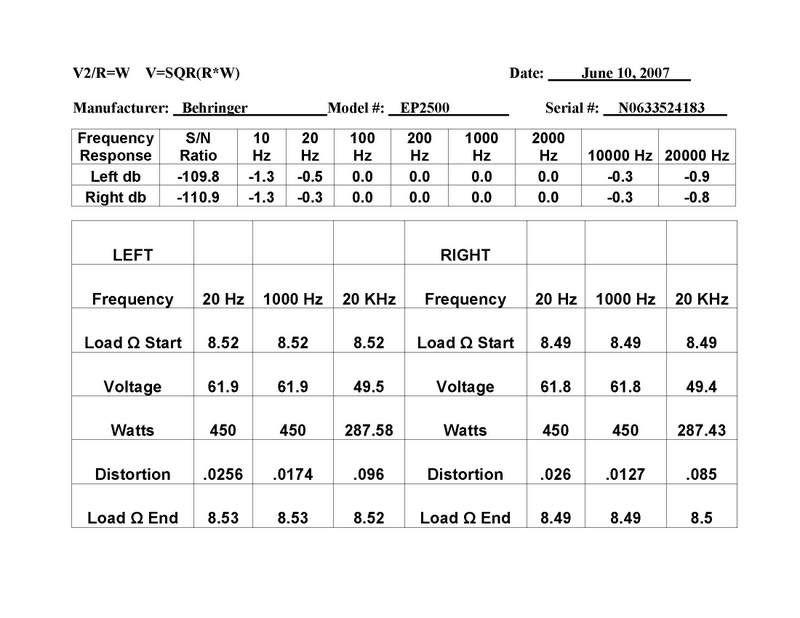
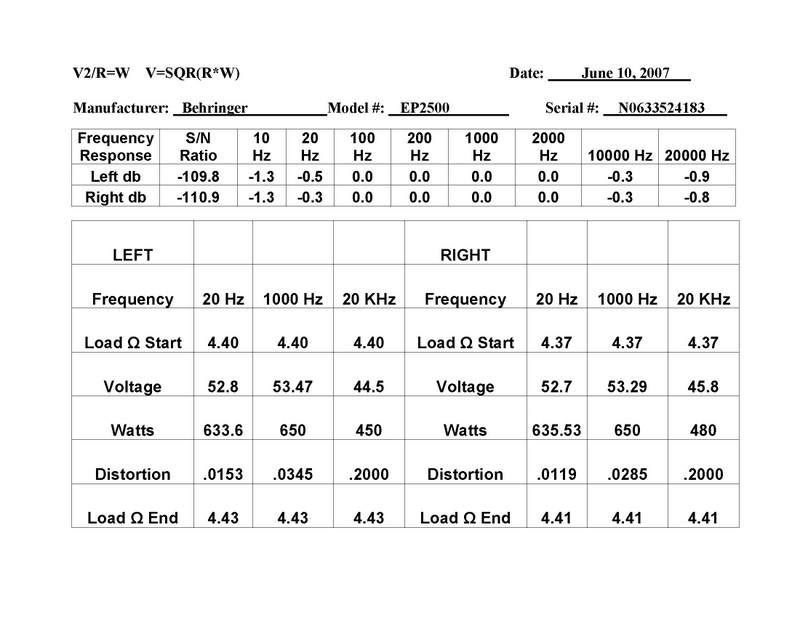
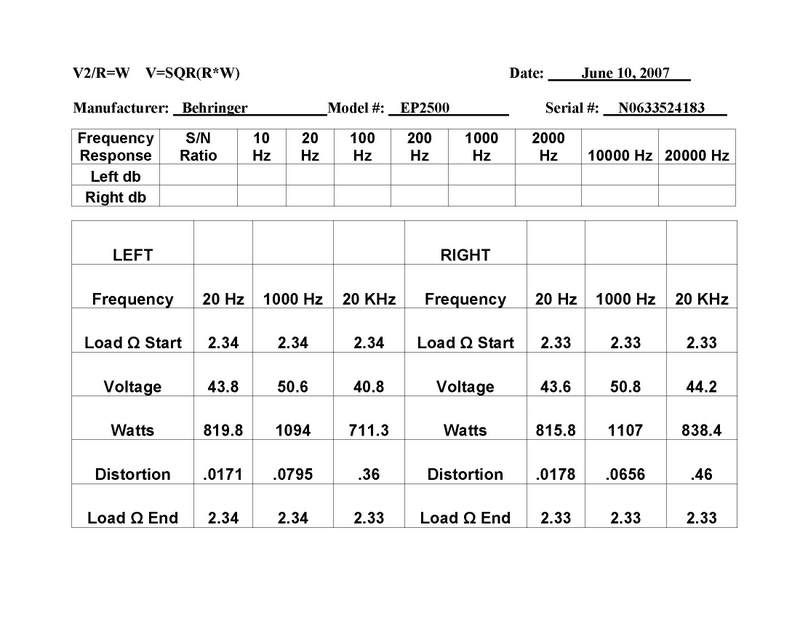
                            Now to throw a monkey wrench into this whole thing, check out the real-world watts/ohms/THD on this amp, and then check its price tag ~$350:


                            Power the woofers with this, and the mids +Tweets with your trusty RB-1090; problem solved. :P

                            Comment

                            • DL86
                              Senior Member
                              • Sep 2005
                              • 271

                              #15
                              I recon you would be hard pressed to hear a difference. Spend your money on something with guaranteed improvements like room treatment or a nice sub. I recently got my SVS PB-13 Ultra and it has provided me with the greatest improvement in my sound over any other electronic peice of equipment I have bought or upgraded from.

                              Comment

                              • thezone
                                Member
                                • Jun 2008
                                • 49

                                #16
                                I second that, all the guys at my local specialist hi-end hi-fi shop are saying that they prefer the sound of older bigger rotel amp models to the new ice stuff. I f you really want to improve your sound get a couple of active subs with internal crossovers and run a second send of L & R pre-outs to them whilst listening to stereo. Doesn't matter how good your speakers are this will improve the overall sound. Don't need to be loud just a nice bottom end presence.
                                RSP-1570
                                RMB-1095
                                Primare PRE-30
                                Yamaha CD-S2000
                                Technics SL-1200MKII
                                Pro-Ject Tube Box II
                                Dynaudio Contour S3.4's
                                Dynaudio Contour SCX
                                2 x M&K V75 subs

                                Comment

                                • style
                                  Super Senior Member
                                  • Feb 2006
                                  • 1562

                                  #17
                                  Hi thezone,

                                  You have reason but is a personal taste.

                                  I prefer the 1092 (I was also 1075/1090) but also depends on the room and other factors.

                                  It is not only with the power amplifier you get the best sound.

                                  Greetings from Switzerland
                                  Omar

                                  Comment

                                  Related Topics

                                  Collapse

                                  • Glenn
                                    Damping factor
                                    by Glenn
                                    I am still in the process of learning and selecting/setting up my home theatre. I have noticed that multi-channel amps usually have a much lower damping factor than 2 channel amps.

                                    When listening to 2 channel source material driving B&W 9NT's, would there be a real world difference...
                                    30 June 2003, 18:09 Monday
                                  • Alaric
                                    Damping Factor relevance
                                    by Alaric
                                    I've read bunch of rave (and not so rave) reviews of Rotel's Class D amplifiers recently and have a question . The damping factor is higher in Rotel's Class A/B amps , much higher for the big amps , than the new Class D's. So does outright power control a speaker better or is damping factor the predominant...
                                    06 June 2006, 11:13 Tuesday
                                  • technodanvan
                                    Exploring Common DIY Terminology - Damping Factor
                                    by technodanvan
                                    Damping Factor

                                    The damping factor is a measure of the amplifier's ability to control the movement of a loudspeaker's voice coil and bring it to a stop after the audio signal has stopped. It quantifies an amplifier's ability to provide an electrical damping effect on the speaker. Mathematically, the damping factor is defined as the ratio of the loudspeaker's nominal impedance (typically 4 or 8 ohms) to the output impedance of the amplifier. It is usually expressed as a number, such as...
                                    18 July 2023, 12:05 Tuesday
                                  • Stevebez
                                    Amplifier Damping Factor - 1075 /1080 ?
                                    by Stevebez
                                    I am tempted to add a 1080 to my 1066/1075 setup to drive the fronts - which i plan to upgrade too from my meagre Boston Micros. This idea, encouragingly, seems to be a popular upgrade path of others too ! Upgraditis seems to be infectious! I have even considered whiping out the old soldering iron...
                                    03 April 2004, 15:08 Saturday
                                  • wasabichondro
                                    damping factor
                                    by wasabichondro
                                    I know numbers are not everything, but I was wondering why Classe doesn't spec the damping factor for their amplifiers? Is it called something else on their spec?
                                    26 December 2009, 14:48 Saturday
                                  • Loading...
                                  • No more items.
                                  Working...
                                    Searching...Please wait.
                                    An unexpected error was returned: 'Your submission could not be processed because you have logged in since the previous page was loaded.

                                    Please push the back button and reload the previous window.'
                                    An unexpected error was returned: 'Your submission could not be processed because the token has expired.

                                    Please push the back button and reload the previous window.'
                                    An internal error has occurred and the module cannot be displayed.
                                    There are no results that meet this criteria.
                                    Search Result for "|||"