Finalist Build With a Couple of Wrinkles

Collapse
This topic is closed.
X
X
 
  • Time
  • Show
Clear All
new posts
  • cjd
    Ultra Senior Member
    • Dec 2004
    • 5570

    #46
    McMaster has 2.5" ID tubing, and plumbing supply shops may also have it available. You'd just have to fabricate the port ends, which in my experience is quite simple to do if you're handy with a router.
    diVine Sound - my DIY speaker designs at diVine Audio

    Comment

    • Jim Holtz
      Ultra Senior Member
      • Mar 2005
      • 3224

      #47
      Originally posted by cfbuck
      Jim or Curt

      If you are reading this, PE has no stock of the 2.5" port. What would be the alternative?

      Thanks in advance.

      Fred
      Hi Fred,

      THIS ONE will work just fine too. Cut it to length and you'll be good to go.

      Jim

      Comment

      • cfbuck
        Member
        • Jan 2007
        • 79

        #48
        Oak Veneer-I Hate It

        I have 4 sheets of raw red oak veneer, 10' long, tapering from 9" to 7.5" along its length. The veneer panels have to be seamed down the middle in a bookmatched pattern to gain the required width of the panels of the cabinet. Normally to make the middle seam, the veneer can be stacked one leaf on top of the other like two book pages, then sliced through both sheets with a utility knife having a new blade and a steel ruler guide. This veneer is very brittle. The knife pressure causes the weak softwood grain to crumble leaving a rough uneven edge.

        The only way to create a usable edge for the seam on this veneer is to use a shooting board and a handplane. Trap the two sheets to be seamed between two straight flush boards, letting the veneer edges overhang the two boards by a 1/16" and use the boards as a plane guide. Plane the veneer until the overhanging edge disappears under the guide while holding the top board under pressure to keep the veneer edges from collapsing under the plane. A sharp plane will be able to stop the splintering of the grain and produce a straight edge. When the sheets are opened up and the planed edges fit to each other, the seam should be tight.

        I use paper veneer tape to hold the edges together. The side having the veneer tape should be the non glue side of the veneer. Hold the edges tightly together and run a moistened 2" piece of tape across the seam every 4" or so. Then I like to run joining pieces of tape spanning the stitching tapes the entire length of the seam.

        Click image for larger version

Name:	Finalist2ShtsSideBM.jpg
Views:	1020
Size:	36.1 KB
ID:	858267

        Click image for larger version

Name:	FinalistBMAllTaped.jpg
Views:	1031
Size:	35.9 KB
ID:	858268

        Click image for larger version

Name:	FinalistBMPartlTape.jpg
Views:	986
Size:	26.7 KB
ID:	858269

        Click image for larger version

Name:	FinalistBckVnrd.jpg
Views:	1005
Size:	36.6 KB
ID:	858270

        Click image for larger version

Name:	FinalistBMGlueSide2.jpg
Views:	1112
Size:	35.0 KB
ID:	858271
        Last edited by theSven; 16 December 2023, 14:53 Saturday. Reason: Update image location
        "Never underestimate that a small group of thoughtful, committed people can change the world; indeed it's the only thing that ever has."
        ~Margaret Mead

        Comment

        • Steve Manning
          Moderator
          • Dec 2006
          • 2117

          #49
          Rather you than me on that oak veneer, it does sound like a pain from what your describing. Having not tried this myself, have you tried this approach http://www.veneersupplies.com/produc...eneer-Saw.html my understanding is they work far better than a knife, leaving a nice clean edge?

          Steve
          Hold on to your butts - It's about to get Musical!


          WEBSITE: http://www.smjaudio.com/

          Comment

          • cfbuck
            Member
            • Jan 2007
            • 79

            #50
            Seaming the unruly veneer

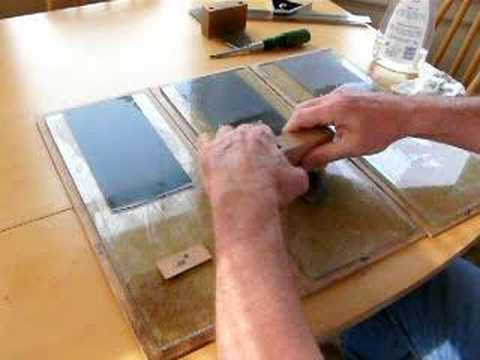
            The shooting board that I made for this job is just 2 pieces of MDF cut straight and joined at the ends with some toilet bolts to hold the two boards in line which will provide support for the two veneer edges to be jointed. If the veneer is not held tight at the joint line, the plane cannot cut the wood as it will bend and collapse. Only a small sliver of veneer can be visible outside of the clamping boards.

            You can see a small white band on the bottom edge of the shooting board which is about 3/16" wide. It is a piece of iron-on white vinyl edging for melamine. This provides the guide for the plane bottom edge and the blade rides above the white strip. Since the blade sticks out below the bottom of the plane, the blade will cut the depth that it protrudes. For this veneer, it has to be set very fine or the veneer starts to shred between the early and late wood.

            The blade also has to be sharp. To see a great sharpening method which is also inexpensive to try, search out the Brent Beach sandpaper method. Here is a YouTube video showing how he does it:


            The shavings from the plane and this veneer are very short. Normally I work in cherry veneer which would give long curls unlike this oak.

            Click image for larger version

Name:	FinalistShootingBrdPlnd.jpg
Views:	995
Size:	47.1 KB
ID:	858272

            Click image for larger version

Name:	FinalistShtgbrd.jpg
Views:	956
Size:	25.8 KB
ID:	858273
            Last edited by theSven; 16 December 2023, 14:54 Saturday. Reason: Update image location
            "Never underestimate that a small group of thoughtful, committed people can change the world; indeed it's the only thing that ever has."
            ~Margaret Mead

            Comment

            • cfbuck
              Member
              • Jan 2007
              • 79

              #51
              Originally posted by Steve Manning
              Rather you than me on that oak veneer, it does sound like a pain from what your describing. Having not tried this myself, have you tried this approach http://www.veneersupplies.com/produc...eneer-Saw.html my understanding is they work far better than a knife, leaving a nice clean edge?

              Steve
              You know Steve, I don't have a veneer saw. I'll get one to try on this stuff if I have any left over. Because I mostly use cherry, a fine grained wood, I never experience this splitting and shredding between the early and late growth grain. I usually just need a new blade in the utility knife and a steel edge ruler as a guide. From the behaviour of the oak with sharp cutting tools, especially the plane, I think that the saw would also rip and tear away. One of the seams on the oak kept tearing away so much that I resorted to sanding using the shooting board. This stopped the splitting enough that I was able to get a straight line seam but it sure is tedious.

              I had to construct a shooting board to plane an edge with some Sappele veneer because it was brittle and the grain was wavy. It was used on the speakers in the photos. The shooting board worked beautifully. The Sappele, the inner field in the speaker side, had a wave amplitude of about .5" but when cut with a sharp plane it behaved both with and against the grain if the veneer was properly supported by the shooting board. BTW, the picture frame outer border is Anigre. I used the picture frame border so that I wouldn't have to seam the Sappele. The upper photo shows the speaker when first constructed and the second one shows the darkening effect of sun aging.

              Click image for larger version

Name:	3Way3d.jpg
Views:	1014
Size:	91.7 KB
ID:	858274

              Click image for larger version

Name:	3 Way Side.jpg
Views:	1083
Size:	41.4 KB
ID:	858275
              Last edited by theSven; 16 December 2023, 14:54 Saturday. Reason: Update image location
              "Never underestimate that a small group of thoughtful, committed people can change the world; indeed it's the only thing that ever has."
              ~Margaret Mead

              Comment

              • cfbuck
                Member
                • Jan 2007
                • 79

                #52
                Hide Glue a NO GO

                With each build I try to learn a little bit more. With this veneer, I was concerned about glue bleed through because the oak is going to be stained dark. The 2nd photo shows bleed through with Titebond. Any PVA glue on the surface will prevent stain penetration. I use Titebond Cold Press Veneer Glue which is a form of PVA but it is dark and it dries harder than yellow PVA. It also has a longer open time allowing positioning and clamping time. However, it will not stain either.

                I purchased some West System Epoxy to use. It also will not stain. The veneer is thin and also has worm holes. This will cause bleed through onto the outer surface preventing stain penetration. So I have nixed the West system as well.

                So, I bought some hide glue and made a veneering hammer. I watched some YouTube videos and proceded to experiment using an old coffee pot as the double boiler to heat the glue. The small piece of cherry veneer that I tried went on beautifully. Emboldened, I tried a couple of oak pieces, seaming the join when gluing the two sides down. I really liked the result and cutting the seam between two pieces while gluing down was a piece of cake. the first photo shows these two attempts.

                I tried to use the technique on the first speaker bottom. Sorry, no photos, as the method requires quick quick work and I did not want to pick up a camera with sticky gluey fingers. I got the first half sheet on just fine. The second half sheet was layed down overlapping the first sheet prior to cutting the seam, and I hammered it down (squeegee really) but the ripples in the raw veneer would not let the veneer sit flat. Perhaps I squeegeed too much glue out or the glue got too cold. Various techniques are used to flatten the veneer the next day. these are shown on YouTube, some contradictory, of course. The iron and steam method did not make it lay flat-the curl popped right back up. Whatever the reason, thinking that the sides are twice as large as the bottom, I gave up the idea of using hide glue until I have more experience with it. I sanded it off and reglued new pieces wiith Titebond. That piece is the one in the photo.

                The 2nd photo shows the first speaker bottom. I had tearout along the endgrain when I triimmed the edge. I could not find the small pieces to glue back in. Knowing that the hide glue will take stain, I mixed up a batch of hide glue and oak sawdust. I filled the cavities in with that mixture. After a day, it was hard enough to sand and scrape flush with the surface. It is visible at the bottom right edge of the photo. Since it is the bottom, I'll trust that I can make the patches invisible with stain and perhaps some gel stain painted on like faux painting. Thhe experience with the end grain trimming made me be very vigilant with the sides that will show.

                Click image for larger version

Name:	GlueBleedThru.jpg
Views:	1010
Size:	51.5 KB
ID:	858276

                Click image for larger version

Name:	012.jpg
Views:	1100
Size:	49.2 KB
ID:	858277
                Last edited by theSven; 16 December 2023, 14:54 Saturday. Reason: Update image location
                "Never underestimate that a small group of thoughtful, committed people can change the world; indeed it's the only thing that ever has."
                ~Margaret Mead

                Comment

                • PMazz
                  Senior Member
                  • May 2001
                  • 861

                  #53
                  The problem is the Red Oak, which is open-pored. There is a reason they only make wine barrels out of white oak. Red oak would leak! If you want to get a feel for how open-pored it is, try soaking a small chunk of red oak in a little soapy water. Blow thru the end and you have a bubble factory.
                  Birth of a Media Center

                  Comment

                  • cfbuck
                    Member
                    • Jan 2007
                    • 79

                    #54
                    Originally posted by PMazz
                    The problem is the Red Oak, which is open-pored. There is a reason they only make wine barrels out of white oak. Red oak would leak! If you want to get a feel for how open-pored it is, try soaking a small chunk of red oak in a little soapy water. Blow thru the end and you have a bubble factory.
                    You are perfectly correct and I should have mentioned that as well. In addition to the open pores, this particular veneer has holes and splits that you can see if you hold it up to the light. There are a couple of insect holes on each 24 x 9 panel as well, the earlywood seems to be thinner when the veneer was sliced. Certainly, much more backlight comes through the veneer in the light grain earlywood than would be attributable to just the colour of the rings. The porosity of the earlywood rings would allow bleedthrough but the bleedthrough is not consistent across the panel. Some areas have it while others don't. When the veneer is held up to a light, there are areas where the light comes through much more prominently, leading me to believe that the veneer slicing was not uniform for the sheet.

                    The sheets were probably sitting in the warehouse for some extended period getting quite brittle and dry. But these sheets were all that was available in red oak here. Part of the joy of woodworking is solving the problems that we encounter. I'm sure that this veneer will cover the MDF, just with alot more difficulty than is necessary. Since the bleedthrough seems to be mostly spots, perhaps the stain job can incorporate some similation of wood borer holes with some darker stain spatters.

                    For most speaker builders, paperbacked red oak would be the obvious answer to the problems that this particular species presents. I'm just dissing red oak as it is my least favourite wood to build anything with. I take that back, white oak is worse.
                    Last edited by cfbuck; 21 April 2013, 16:10 Sunday. Reason: Corrections
                    "Never underestimate that a small group of thoughtful, committed people can change the world; indeed it's the only thing that ever has."
                    ~Margaret Mead

                    Comment

                    • PMazz
                      Senior Member
                      • May 2001
                      • 861

                      #55
                      We only use paper or phenolic backed veneer for that reason.

                      I agree with you about oak, I'm just tired of seeing it. We did a whole house's worth of oak cabinets at the shore house of an old customer. We did their kitchen ~18 years ago out of oak and she wanted the same look at the new shore house. Couldn't talk her out of it.
                      Birth of a Media Center

                      Comment

                      • cfbuck
                        Member
                        • Jan 2007
                        • 79

                        #56
                        Originally posted by PMazz
                        We only use paper or phenolic backed veneer for that reason.
                        Professionals need consistency and that is what paperbacked veneer provides. It lays absolutely flat and has no possiblity of bleedthrough. I can see why you make this choice.

                        On the other hand, striking grain patterns such as curly cherry or some of the exotic woods cannot be sourced on paperback around here. If I want these effects, raw veneer is the only way to achieve this.

                        I agree with you about oak, I'm just tired of seeing it. We did a whole house's worth of oak cabinets at the shore house of an old customer. We did their kitchen ~18 years ago out of oak and she wanted the same look at the new shore house. Couldn't talk her out of it.
                        When we cut down the Eastern forests all that oak had to go somewhere useful outside of barn timberframes. But it did set of pattern of acceptance of oak cabinetry which still is in vogue to-day. I couldn't purchase a house with an oak kitchen especially those arch top panels in golden oak. But a cabiinetmaker has to eat, a hobbyist doesn't need to please anyone but themselves. About the only oak furniture I appreciate comes from Stickley and the Greene & Greene designs.
                        "Never underestimate that a small group of thoughtful, committed people can change the world; indeed it's the only thing that ever has."
                        ~Margaret Mead

                        Comment

                        • cfbuck
                          Member
                          • Jan 2007
                          • 79

                          #57
                          One of the Wrinkles-Using old-fashioned cauls, clamps and platens to glue down veneer

                          Most speaker builders use the Heatlock PVA glue and a household iron to set down their veneer. It is tried and true for the hobbyist. I hope that this thread shows a few alternative methods and techniques than those usually used.

                          When I attempted the iron on method on some raw curly maple, I had less than satisfactory results. The veneer split and shrank back from the split opening up an unsightly gap several places in the veneer, mostly along the top of the sides. Most of you are much more successful than I with the hot iron method. I will use the iron on small areas like the facets on Jon Marsh's M8ts. For the rest of the large areas, if I can get two pieces of flat melamine to trap the cabinet surface and the veneer under clamping pressure, I will use it. It has never failed to set the veneer flat for me and never have I experienced any glue creepage.

                          When the surface is large, like the 24 x 15 sides, with this method it is best to use what are called cauls to increase the clamping pressure in the middle of the panel and distribute that pressure evenly over the entire surface. The caul is just a rectangular stick of wood which is planed to have a slight arc or crown. A spruce 2 x 4 is fine, but I have some maple in the photos. The arc prevents the clamps from bowing up the middle of the melamine platen and sets the middle of the panel veneer flat. This techique simulates a press that was used in days gone by with a screw pressure plate or several cauls and threaded rod. I can get these cauls on it about 10 minutes whith the style of clamps thaat I have. That is why the Titebond Cold Press glue is handy because it has a longer open time. Just a note of warning, I don't believe that the Quick Grip type clamps would exert enough pressure to use with cauls.

                          Well-equiped shops that do a lot of veneering will have a press with a vacuum bag instead of the cauls. It is certainly more convenient and faster. It also allows shapes other than rectangular ones to be veneered. The vacuum bag still requires storage of platens of various sizes. Sometimes a small shop has to forgo all the bells and whistles because of space. When I do the Jon Marsh M8t style cabinet, I'm getting one.

                          The 1st photo shows a gap under the left side of the caul but the right side is clamped tight to the platen. The second photo shows both sides clamped down tight. I have about 4 cauls on the 24" length and then I fill in between with as many clamps as I can get around the perimeter, but they probably aren't necessary. I let it sit in the clamps for 2 or more hours. So it is a much slower process than the iron on method.

                          Click image for larger version

Name:	FinalistCaulArc.jpg
Views:	956
Size:	48.8 KB
ID:	858285

                          Click image for larger version

Name:	FinalistCaulFlat2.jpg
Views:	1027
Size:	33.8 KB
ID:	858286

                          Click image for larger version

Name:	FinalistPlattenClamped.jpg
Views:	1042
Size:	54.6 KB
ID:	858287
                          Last edited by theSven; 16 December 2023, 14:55 Saturday. Reason: Update image location
                          "Never underestimate that a small group of thoughtful, committed people can change the world; indeed it's the only thing that ever has."
                          ~Margaret Mead

                          Comment

                          • cfbuck
                            Member
                            • Jan 2007
                            • 79

                            #58
                            Early wood identified incorrectly in earlier post

                            After PMazz pointed out the earlywood being like straws, I took a better look at the veneer. I had identified the early wood as light coloured earlier but that is not correct. The earlywood is the darker grain because it is the open pored wood. The lighter grain is the late season wood and is the lighter colour. Sorry for the misdirection.ops:
                            "Never underestimate that a small group of thoughtful, committed people can change the world; indeed it's the only thing that ever has."
                            ~Margaret Mead

                            Comment

                            • Finleyville
                              Senior Member
                              • Sep 2006
                              • 350

                              #59
                              Keep up the good work. All I see in the above photo is $$$$$ in all of those Bessey clamps!
                              BE ALERT! The world needs more lerts.

                              Comment

                              • cfbuck
                                Member
                                • Jan 2007
                                • 79

                                #60
                                Originally posted by Finleyville
                                Keep up the good work. All I see in the above photo is $$$$$ in all of those Bessey clamps!
                                Yep. That's a lifetime collection of Bessey and Gross Stabill when they go on sale at 4 for $120. I think that I have 3 sets of 4 and a couple of stragglers. These clamps are ideal for woodworking use when laminating boards together. They clamp exactly at rightangles to the plane of the lamination. They are worth every penny I spent, but I use them alot. They are overkill for someone who just builds speakers. I also have an equal number of pipe clamps and F clamps. You can never have too many.

                                But you were supposed to see 2 melamine platens, one on top, the other on the bottom with the veneer under the top one, gluing to the side of the speaker, under a great deal of pressure from the cauls and the clamps. I used to use the pipe clamps to do this but they are much more ackward as the screw would be on the bottom with the pipe pointing upwards. Cost is not an issue when it comes to tools. :W
                                Last edited by cfbuck; 27 April 2013, 09:32 Saturday. Reason: Additional comment
                                "Never underestimate that a small group of thoughtful, committed people can change the world; indeed it's the only thing that ever has."
                                ~Margaret Mead

                                Comment

                                • cfbuck
                                  Member
                                  • Jan 2007
                                  • 79

                                  #61
                                  Spreading the Glue

                                  The Titebond Cold Press Glue is more liquid than regular PVA. I just take a squeeze bottle and run continuous beads back and forth every 1.5" on the surface. Then I take a broken piece of hacksaw blade as a spreader, held in a Vicegrip to keep my hands clean, and, rake the glue over the whole surface. I have scuff sanded the surface to take some of the glaze off the MDF surface prior to glue application. The hacksaw blade scarifies the MDF allowing glue penetration and creating a glue slurry containing MDF particles. I make sure that the edges are coated sufficiently with glue. As the veneer is laid down, it will try to curl up from the edges as the veneer takes on water from the glue. The platen will lay it down but if the edge is starved of glue, it will not be tight to the cabinet along the edge. Then it will be unsupported during the trimming operation. This will allow that maddening tearout to occur. Any lip left on the veneer overlapping the cabinet edge will also tear off into the veneer surface easily.

                                  There is a strip of masking tape around the already veneered surfaces to try to catch the squeeze out and prevent affecting the staining operation later. This helps but sometimes this liquid glue creeps under any tape which is not pressed securely to the edge.

                                  The 3rd photo shows the glue which is a bit too plentiful. There is bleed through to the top surface of the veneer. It comes through the worm holes, splits and the early wood grain which is, as PMazz says, like straws. If you can blow through it, the glue will flow through it.

                                  Click image for larger version

Name:	GlueSpread2.jpg
Views:	931
Size:	27.6 KB
ID:	858300

                                  Click image for larger version

Name:	GlueSqueeze.jpg
Views:	920
Size:	22.0 KB
ID:	858301

                                  Click image for larger version

Name:	TooMuchGlue.jpg
Views:	915
Size:	40.0 KB
ID:	858306
                                  Last edited by theSven; 16 December 2023, 14:55 Saturday. Reason: Update image location
                                  "Never underestimate that a small group of thoughtful, committed people can change the world; indeed it's the only thing that ever has."
                                  ~Margaret Mead

                                  Comment

                                  • cfbuck
                                    Member
                                    • Jan 2007
                                    • 79

                                    #62
                                    This Red Oak Required An Ancient Method for Trimming The Overhang Flush To The Sides

                                    Most builders use their trusty router and a flush trimming bit to remove the veneer overhang. With paperbacked veneer this method works beautifully. With this veneer, however, I'm afraid that the edges would tear away even when trimming the long grain--the end grain would certainly tear out.

                                    I like to use hand tools for this task, especially a very sharp low angle block plane, even on the end grain, if the veneer is well-behaved. Hand work is quiet, contemplative, and, when a piece breaks out from the veneer surface, it can be found and reglued with some masking tape as a clamp while you go have a coffee.

                                    My method--turn the veneer to be trimmed side down onto a cutting surface. Take a steel ruler, a sharp utility knife or Exacto knife using the ruler against the cabinet side to create a 1/16th to 1/8th inch lip of veneer. Trim both long grain sides first, cutting the veneer so that the grain is running towards the outside of the cabinet. If the graiin is running towards the cabinet the potential for the knife to tear out veneer that is glued onto the cabinet is increased. Make several light passes, scoring the veneer in stages until the cut is complete. Cut the endgrain next working in from both outside corners to the middle. Score the veneer almost through, then fold it up to break the veneer, rather than cutting it all the way through. This oak broke into small pieces as this process was completed. The cabinet is then turned upside so that the veneer to be trimmed is on top.

                                    Again,trim the long grain sides first, working grain so that it is always pointing up into the plane blade. I use a low angle block plane that has a very fine setting, allowing a cut depth as little as .001" but more usually about .002". Skew the plane in relation to the surface so that the blade is cutting down against a supported edge. If the lip is about 1/16" this will require quite a few passes. This is a lot slower than a flush trimming bit in a router, but the chances of tearout are much reduced. Take the lip almost flush to the cabinet side. Then use sandpaper or a cabinet scrapper to finish removing the lip. A cabinet scrapper is just a flat rectangular piece of tool steel that used to be used before sandpaper was invented. Unfortunately, like all hand tools, it requires a learning curve to master the art of sharpening it, but it is very handy and controllable for this task and for cleaning up glue squeeze out. It is also used to remove the veneer paper tape after moistening.

                                    Click image for larger version

Name:	KnifeRulerTrim.jpg
Views:	932
Size:	35.9 KB
ID:	858307

                                    Click image for larger version

Name:	Trim WithGrain.jpg
Views:	891
Size:	36.2 KB
ID:	858308

                                    Click image for larger version

Name:	WithGrainPlaneTrim.jpg
Views:	949
Size:	23.2 KB
ID:	858309

                                    Click image for larger version

Name:	EndGrainTrim.jpg
Views:	990
Size:	58.3 KB
ID:	858310
                                    Last edited by theSven; 16 December 2023, 14:56 Saturday. Reason: Update image location
                                    "Never underestimate that a small group of thoughtful, committed people can change the world; indeed it's the only thing that ever has."
                                    ~Margaret Mead

                                    Comment

                                    • cfbuck
                                      Member
                                      • Jan 2007
                                      • 79

                                      #63
                                      Flush Trimming Part 2--End Grain

                                      The end grain always had a ragged edge after trimming with the knife. The tearouts often extended to the cabinet. Care had to be taken not to cause more of this during the trimming process.

                                      The only safe method for me was using 120 grit sandpaper. Working in from the both corners to the middle, a bevel was sanded at a 45 degree angle, sanding only in a downwards motion against the cabinet. When a 1/32" bevel was visible, the sandpaper block was turned to 90 degrees and again, sanding in the downward direction, always against the supported edge, the bevel was removed. This process was continued by creating a bevel and then removing it until the edge was flush with the cabinet. This extremely slow and cumbersome process was discovered to be the only one to work while practising on the first two veneer panels on the bottom of the cabinet. All others produced tearout grain.

                                      The 3rd photo shows the final trim result. The edges turned out better than I expected.

                                      Click image for larger version

Name:	RaggedEndGrain.jpg
Views:	936
Size:	79.5 KB
ID:	858311

                                      Click image for larger version

Name:	SideBtmEdge.jpg
Views:	983
Size:	69.3 KB
ID:	858312

                                      Click image for larger version

Name:	TrimmedSide.jpg
Views:	923
Size:	71.6 KB
ID:	858313
                                      Last edited by theSven; 16 December 2023, 14:56 Saturday. Reason: Update image location
                                      "Never underestimate that a small group of thoughtful, committed people can change the world; indeed it's the only thing that ever has."
                                      ~Margaret Mead

                                      Comment

                                      • cfbuck
                                        Member
                                        • Jan 2007
                                        • 79

                                        #64
                                        Glue Bleed Through and Cleanup

                                        With these three photos, you can see the glue problem. Too much glue was applied to the cabinet, but the veneer softened better with more moisture so I left the excess on. Usually I just have a surface sheen that the hacksaw blade leaves. This time there were small puddles. I forgot that the panel that I was gluing down was in the more porous section of the veneer sheet. The glue bleed through was quite excessive. The puddles correlate to the bleed through quite closely.

                                        The third photo shows the cabinet scrapper that was used to clean up the surface bleed through. Sanding with an orbital sander will be done later. I hope that it will not affect the staining operation too badly.

                                        The two top panels remain to be glued down

                                        Click image for larger version

Name:	P1030204.jpg
Views:	954
Size:	45.0 KB
ID:	858314

                                        Click image for larger version

Name:	P1030258.jpg
Views:	881
Size:	93.3 KB
ID:	858315

                                        Click image for larger version

Name:	P1030259.jpg
Views:	982
Size:	89.0 KB
ID:	858316
                                        Last edited by theSven; 16 December 2023, 14:56 Saturday. Reason: Update image location
                                        "Never underestimate that a small group of thoughtful, committed people can change the world; indeed it's the only thing that ever has."
                                        ~Margaret Mead

                                        Comment

                                        • Finleyville
                                          Senior Member
                                          • Sep 2006
                                          • 350

                                          #65
                                          Originally posted by cfbuck
                                          Yep. That's a lifetime collection of Bessey and Gross Stabill when they go on sale at 4 for $120. I think that I have 3 sets of 4 and a couple of stragglers. These clamps are ideal for woodworking use when laminating boards together. They clamp exactly at rightangles to the plane of the lamination. They are worth every penny I spent, but I use them alot. They are overkill for someone who just builds speakers. I also have an equal number of pipe clamps and F clamps. You can never have too many.

                                          But you were supposed to see 2 melamine platens, one on top, the other on the bottom with the veneer under the top one, gluing to the side of the speaker, under a great deal of pressure from the cauls and the clamps. I used to use the pipe clamps to do this but they are much more ackward as the screw would be on the bottom with the pipe pointing upwards. Cost is not an issue when it comes to tools. :W
                                          I did see those platens, but the amount of Bessey clamps took all my attention! lol

                                          I wish I had that amount of clamps when I assembled my Finalists. (Final build thread to be posted soon...) I am afraid that some of my glue-ups are less than ideal possibly creating a sub-standard enclosure. Time will tell...
                                          BE ALERT! The world needs more lerts.

                                          Comment

                                          • cfbuck
                                            Member
                                            • Jan 2007
                                            • 79

                                            #66
                                            Final Top Veneered--A Few Nicks--Any Advice?

                                            Just finished the 2nd top--the last veneer panel. Unfortunately the worst piece of veneer was left as I lost the best piece when I attempted to use the hot hide glue. This piece was from the narrow end of the sheet and was the most brittle and crumbly.

                                            As careful and delicate as I could be, sanding only in one direction, with the grain and towards the outside edge, I still had a few pieces of fibre break at the edge leaving small voids, maybe 1/16th inch square. This is visible in the first photo, the largest one just to the left of the centre line.

                                            What suggestions do any of you have to fill these in? I can mix up some epoxy and sawdust but I'm concerned that they will be too visible when stained.

                                            The other two photos of edges are cheery veneer. They are the same speakers as my avatar. I added them just to show the contrast of fine grained wood. The edge is sustained, without any breaks from back to front. These were trimmed with sharp chisels and a plane. No tearout. The other interesting thing, is the colour change. The avatar is a photo of the cherry when new but the poly finish was on them. These photos show the aging of the cherry and the oil poly together over 6 years. These is no stain on the speakers. The difference is rather dramatic in the photos.

                                            Click image for larger version

Name:	P1030261.jpg
Views:	863
Size:	74.3 KB
ID:	858344

                                            Click image for larger version

Name:	P1030262.jpg
Views:	952
Size:	65.5 KB
ID:	858345

                                            Click image for larger version

Name:	P1030264.jpg
Views:	884
Size:	59.7 KB
ID:	858346
                                            Last edited by theSven; 16 December 2023, 14:56 Saturday. Reason: Update image location
                                            "Never underestimate that a small group of thoughtful, committed people can change the world; indeed it's the only thing that ever has."
                                            ~Margaret Mead

                                            Comment

                                            • PMazz
                                              Senior Member
                                              • May 2001
                                              • 861

                                              #67
                                              You're going to have issues trying to stain those with all that bleed thru. May want to try a tinted clear finish instead. For the tear out, get some color on them first and then go for the patching. Epoxy and sawdust would probably hold up the best on an edge. Tint the sawdust before mixing.
                                              Birth of a Media Center

                                              Comment

                                              • Steve Manning
                                                Moderator
                                                • Dec 2006
                                                • 2117

                                                #68
                                                Hey Fred ..... that sucks with the chipping, it always seems to happen at the end doesn't it. I just tried a new technique for filling holes that I ran across by a finishing expert that worked very well for color matching, I have a link and some pictures in my Jensen post. It worked better than anything I've tried before, though I can't speak to how it will hold up over time with regard to matching color changes of the real wood. I did use different products than what he did, but they seemed to work well.

                                                Steve
                                                Hold on to your butts - It's about to get Musical!


                                                WEBSITE: http://www.smjaudio.com/

                                                Comment

                                                • cfbuck
                                                  Member
                                                  • Jan 2007
                                                  • 79

                                                  #69
                                                  I've been away and unable to reply or work on the speakers. Sorry for the delay in replying to PMazz and Steve Manning.

                                                  I will probably use the coloured sawdust and expoxy simply because it has a lot of strength on the edge. The coloured putty was a very useful tip. I have a hobby business--home renovation and it will come in handy there. I have never seen that brand of putty but I suspect that it is similar to ordinary window glazing putty which I believe is linseed based. The only reservation that I have is the drying time. If I use window glazing, I have to let it dry for at least a week and sometimes as long as a month before finishing.

                                                  I share your concern about the bleed through PMazz. I've glued the remainder of the veneer onto MDF strips attempting to vary the amount of bleedthrough from totally excessive to almost none. The photo shows the variety that is available for staining samples. The largest panel has been sanded. The rest will be sanded as well to remove the surface glue. When the staining method has been decided upon, at least sample boards will show the effects of the glue on the stain.

                                                  The Parts Express drivers and crossover parts have arrived. So the crossovers can be assembled while the staining experiments are being performed.

                                                  Click image for larger version

Name:	P1030272.jpg
Views:	808
Size:	90.5 KB
ID:	858368
                                                  Last edited by theSven; 16 December 2023, 14:57 Saturday. Reason: Update image location
                                                  "Never underestimate that a small group of thoughtful, committed people can change the world; indeed it's the only thing that ever has."
                                                  ~Margaret Mead

                                                  Comment

                                                  • cjd
                                                    Ultra Senior Member
                                                    • Dec 2004
                                                    • 5570

                                                    #70
                                                    I have heard that using a scraper works better than sanding for cleaning out this kind of problem - perhaps because it doesn't grind a tiny bit of the dust back into whatever pores remain.

                                                    I'll be quite interested in how the samples turn out.

                                                    C
                                                    diVine Sound - my DIY speaker designs at diVine Audio

                                                    Comment

                                                    • Sahren7
                                                      Junior Member
                                                      • Sep 2012
                                                      • 10

                                                      #71
                                                      cfbuck

                                                      Great build thread - very informative.

                                                      Off topic, but what is the design shown in your avatar and/or post 51?

                                                      Comment

                                                      • cfbuck
                                                        Member
                                                        • Jan 2007
                                                        • 79

                                                        #72
                                                        Originally posted by Sahren7
                                                        cfbuck

                                                        Great build thread - very informative.

                                                        Off topic, but what is the design shown in your avatar and/or post 51?
                                                        Hi Sahren,

                                                        The build in the avatar has an older ribbon, the Raven R1 and the Seas Excel W015CY001 woofer. The crossover design was by Dennis Murphy. The Excel has to reach up a bit too far to the Raven in the 2-Way. It is a good speaker but is vastly improved by adding an older 10` Peerless 850046, the CSX line which has been discontinued years ago but still is a good woofer (Post 51). The Excel is relieved of the bass duties and reconfigured a bit higher to reach the R1. I like them. They are a combination of Dennis` MBOW3 bass unit and a smaller version similar in concept to Jim Salk`s HT1(www.salksound.com)--a Seas W018E001 and the AC S2 ribbon. They were my 3rd build a few years ago.
                                                        "Never underestimate that a small group of thoughtful, committed people can change the world; indeed it's the only thing that ever has."
                                                        ~Margaret Mead

                                                        Comment

                                                        • cfbuck
                                                          Member
                                                          • Jan 2007
                                                          • 79

                                                          #73
                                                          Originally posted by cjd
                                                          I have heard that using a scraper works better than sanding for cleaning out this kind of problem - perhaps because it doesn't grind a tiny bit of the dust back into whatever pores remain.

                                                          I'll be quite interested in how the samples turn out.

                                                          C
                                                          Good to see you still looking in Christopher. I`m taking your suggestion to the samples. I`ve sanded a few and scrapped a few. I have about 5 sq. ft. of sample, some of which is also glued with hot hide glue. It will be interesting to see if any difference results during the staining process.

                                                          The sequence of photos shows the excess glue bleedout, the excess scrapped off using a scraper, the very excessive bleed through and that sanded off. Note that the scraper, although not freshly sharpened, still gives wood shavings rather than dust. This is what C was referring to regarding the dust accumulating and getting trapped in the open pores. I think that I will vacuum both types of samples before stainging.

                                                          I have to admit that I have only stained one project. That was an oak vanity. I tried to mimick mission oak. It was a little too green hued from my perspective. I used a Lee Valley`s Honey Amber aniline waterbased dye followed by fumed oak waterbased dye and a polyurethane oil finish, AFAIK. The green hue is visible on the bottom rail. there is a variation of colour from door to door as well. I did not use conditioner but the wood was all from the same tree as far as I know. It was from the same pallet of red oak, not particularly the greatest as it had a few splits and cracks. The baffles will be from the same pallet as well. You can see some of the splits in the earlier posts. They show up a a black line. I`m hoping that staining will conceal any of these lines.

                                                          If anyone has successfully strained red oak a dark brown with a reddish or yellow undertone, I`d like to hear your formula.

                                                          Click image for larger version

Name:	ExcessiveBleedOut.jpg
Views:	1387
Size:	90.3 KB
ID:	858370

                                                          Click image for larger version

Name:	EXcessSanded Off.jpg
Views:	1289
Size:	84.6 KB
ID:	858371

                                                          Click image for larger version

Name:	GlueScrappedOff.jpg
Views:	1348
Size:	89.0 KB
ID:	858372

                                                          Click image for larger version

Name:	ScrappingShavings2.jpg
Views:	1364
Size:	92.6 KB
ID:	858373

                                                          Click image for larger version

Name:	Vanity.jpg
Views:	1445
Size:	97.9 KB
ID:	858374
                                                          Last edited by theSven; 16 December 2023, 14:57 Saturday. Reason: Update image location
                                                          "Never underestimate that a small group of thoughtful, committed people can change the world; indeed it's the only thing that ever has."
                                                          ~Margaret Mead

                                                          Comment

                                                          • AdelaaR
                                                            Senior Member
                                                            • Dec 2010
                                                            • 480

                                                            #74
                                                            Great build ... lotsa pictures ... what could we want more?

                                                            Comment

                                                            • cfbuck
                                                              Member
                                                              • Jan 2007
                                                              • 79

                                                              #75
                                                              Been a While

                                                              I haven't posted in quite some time because I haven't got the colour of the stain matched yet. In fact I haven't even had time to be on the Forum to view other threads. In the past couple of days I have done some things on the speakers so I will post them over the next day.

                                                              Sorry for the delays.
                                                              Last edited by cfbuck; 13 July 2013, 16:14 Saturday. Reason: typo
                                                              "Never underestimate that a small group of thoughtful, committed people can change the world; indeed it's the only thing that ever has."
                                                              ~Margaret Mead

                                                              Comment

                                                              • JonMarsh
                                                                Mad Max Moderator
                                                                • Aug 2000
                                                                • 16038

                                                                #76
                                                                With DIY projects, there are ALWAYS delays! Life happens! (Like myself, working this weekend again!)

                                                                Better you make progress for yourself than worry about posting to us! :W
                                                                the AudioWorx
                                                                Natalie P
                                                                M8ta
                                                                Modula Neo DCC
                                                                Modula MT XE
                                                                Modula Xtreme
                                                                Isiris
                                                                Wavecor Ardent

                                                                SMJ
                                                                Minerva Monitor
                                                                Calliope
                                                                Ardent D

                                                                In Development...
                                                                Isiris Mk II updates- in final test stage!
                                                                Obi-Wan
                                                                Saint-Saëns Symphonique/AKA SMJ-40
                                                                Modula PWB
                                                                Calliope CC Supreme
                                                                Natalie P Ultra
                                                                Natalie P Supreme
                                                                Janus BP1 Sub


                                                                Resistance is not futile, it is Volts divided by Amperes...
                                                                Just ask Mr. Ohm....

                                                                Comment

                                                                • cfbuck
                                                                  Member
                                                                  • Jan 2007
                                                                  • 79

                                                                  #77
                                                                  Crossovers Built

                                                                  Thanks Jon. I just felt a bit guilty for not moving the thread along. I was not being very punctual about getting the test boards over to see if they matched the furniture. I could have been building the crossovers and completeing the cabinets but I was fixated on getting the stain matching done first. So I have moved on while I try to get the colour right.

                                                                  I built the crossovers first. I wanted to make sure that they would go in the woofer hole so the HDF bases were cut 6.5" wide and about 11" long. I started to plan a ladder with the signal on the top length of copper wire and the ground along the bottom. But the resistors were so long that I couldn't mount them neatly between the signal and ground feeds and still get all the components on the board. But the circuits are organized in the photo from left to right as woofer, mid and then tweeter. The wiring points are labelled on the HDF. The hookup wire is only one colour so each is labelled with a piece of electrical tape at connection end.

                                                                  The individual driver circuits were tested with some old drivers to make sure that they would not short the new drivers.

                                                                  Click image for larger version

Name:	IMGP2606.jpg
Views:	1310
Size:	74.1 KB
ID:	858482

                                                                  Click image for larger version

Name:	IMGP2607.jpg
Views:	1230
Size:	51.9 KB
ID:	858483
                                                                  Last edited by theSven; 16 December 2023, 14:58 Saturday. Reason: Update image location
                                                                  "Never underestimate that a small group of thoughtful, committed people can change the world; indeed it's the only thing that ever has."
                                                                  ~Margaret Mead

                                                                  Comment

                                                                  • cfbuck
                                                                    Member
                                                                    • Jan 2007
                                                                    • 79

                                                                    #78
                                                                    Cutting the Holes in the Inner Baffle

                                                                    The holes were layed out according to Jim's diagram. The weather around here has been so wet that there were few opportunities to work outside for any extended time. The weather this past week allowed the work to be done. This keeps the dust outside, a preferable state. I used a .25" upcut spiral onsrud bit and the Jasper Jig.

                                                                    The hole for the mid has to be inside the PVC pipe. The way my cabinets are assembled, this means cutting blind and hoping that the PVC is installed where I think they actually are located. Since it has been 2 months and I neglected to mark the cabinets adequately, the mid tunnel hole on the back of the speaker will have to be carefully cut. Jim calls for a 7" d rabbet at a depth of .5" concentric to the 6" pipe d. My port tube is significantly larger so I reduced the larger diameter to 6.5" and cut it first at a depth of .25". Then a 5.75" concentric through hole was cut. The hole as finished with a flush cut using a bearing bit to the pipe wall. On the inner baffle, the hole will have no problem being inside the pipe, as it was cut at a 5" diameter. I think that this is big enough for the VIFA clearance. The tweeter is cut at a 3" d and the woofer at 7.5".

                                                                    Click image for larger version

Name:	BafflHolesCut3.jpg
Views:	1151
Size:	32.1 KB
ID:	858484

                                                                    Click image for larger version

Name:	HolesMarked.jpg
Views:	1316
Size:	29.0 KB
ID:	858485
                                                                    Last edited by theSven; 16 December 2023, 14:58 Saturday. Reason: Update image location
                                                                    "Never underestimate that a small group of thoughtful, committed people can change the world; indeed it's the only thing that ever has."
                                                                    ~Margaret Mead

                                                                    Comment

                                                                    • cfbuck
                                                                      Member
                                                                      • Jan 2007
                                                                      • 79

                                                                      #79
                                                                      Cutting and Veneering Mistakes

                                                                      I should have thought about the backside holes more thoroughly in light of the splintery veneer. The upcut spiral bit ripped the oak veneer in jagged fashion as the outer hole was cut (this is visible in the rather yellow photo which is not in focus). I should have known this. For the second speaker I switched to a downcut spiral bit and this cured the problem. A straight cut bit would have no problem either. A plug will have to be formed to close the mid tunnel for nearwall use. This will cover the edge. Additionally, I will probably have to provide a ring for far wall use to cover the jagged edge. I also cut depth of the recess differently on the two speakers. I haven't thought through the correction on that yet.

                                                                      On the out of focus photo, you may also notice the smaller port hole has a nick in the edge at 11 o'clock. Using the Jasper Jig, one must be careful to pull towards the centre as the through cut is completed or the bit will want to pull the router towards the outside if a climb cut is being used. I reverse direction of cut with each new depth and I wasn't careful enough as the cut was completed. I think that the flange will cover the nick.

                                                                      When I cut the second speaker back, I got a shock. A piece of veneer between the mid tunnel hole and the port hole ripped off the surface. Visible underneath was a piece of veneer tape. Carelessly, I had mounted the back veneer tapeside down. The tape is never to be underneath the veneer. That is why the veneer came loose. I had thrown away all the cutoffs unless they were big enough to be used as samples for the colour matching. Fortunately, my housekeeping isn't superb and under my router table, a stray piece was found on the floor by accident. I spliced it in and glued it on as per photos.

                                                                      Click image for larger version

Name:	VenrRepair.jpg
Views:	1219
Size:	34.9 KB
ID:	858486 Click image for larger version

Name:	VenrTapeErr.jpg
Views:	1201
Size:	27.0 KB
ID:	858487

                                                                      Click image for larger version

Name:	VenrUpCutErr.jpg
Views:	1126
Size:	24.4 KB
ID:	858488 Click image for larger version

Name:	VenrRepaired.jpg
Views:	1166
Size:	30.8 KB
ID:	858489
                                                                      Last edited by theSven; 16 December 2023, 14:58 Saturday. Reason: Update image location
                                                                      "Never underestimate that a small group of thoughtful, committed people can change the world; indeed it's the only thing that ever has."
                                                                      ~Margaret Mead

                                                                      Comment

                                                                      • cfbuck
                                                                        Member
                                                                        • Jan 2007
                                                                        • 79

                                                                        #80
                                                                        Battens for Front Edge of Cabinet

                                                                        One of the areas on veneered speakers which is most subject to dings and nicks is the sharp front edge of the cabinet, especially if it does not have a round over. Many have inserted a solid wood edge around the front baffle to avoid the fragile edge of veneers. One of the wrinkles in this build features a solid wood baffle. This accomplishes the same thing as the solid wood edges. As noted in the initial post, unlike MDF, solid wood expands and contracts with moisture differences. If the solid wood baffle extended from side to side, it would not always fit flush to the cabinet side due to this movement. By deliberately cutting it narrow and providing a batten around the cabinet edge on which the baffle floats, this change in size will be unnoticeable.

                                                                        The roundover on most speakers is also used to smooth out the diffraction effects. Although the roundover on this solid wood baffle will not be a smooth curve, it should have similar effects to a roundover. There will be a bump between the batten and the curve on the baffle itself.

                                                                        As shown in the photos, for the two cabinets, four lengths and four widths of solid oak was milled .375" x .675" with a .25" roundover applied. It was then cut and glued around the edge of the front baffle. A pin nailer was used to tack each batten while the glue cured. Care is taken to ensure that the batten covers the veneer edge. Of course the driver holes have to be cut before these battens are added. This also seals that rabbet gap on the front of the cabinets if the abundant glue did not fill the gap.

                                                                        A scrapper or sandpaper is used to flush any overhanging batten edges to the veneer on the cabinet sides.

                                                                        Click image for larger version

Name:	2BAttens.jpg
Views:	1258
Size:	42.7 KB
ID:	858502

                                                                        Click image for larger version

Name:	Battens.jpg
Views:	1112
Size:	46.4 KB
ID:	858503 Click image for larger version

Name:	FullBattens.jpg
Views:	1214
Size:	33.5 KB
ID:	858504

                                                                        Click image for larger version

Name:	TopBatten.jpg
Views:	1121
Size:	28.0 KB
ID:	858505
                                                                        Last edited by theSven; 16 December 2023, 14:59 Saturday. Reason: Update image location
                                                                        "Never underestimate that a small group of thoughtful, committed people can change the world; indeed it's the only thing that ever has."
                                                                        ~Margaret Mead

                                                                        Comment

                                                                        • JonMarsh
                                                                          Mad Max Moderator
                                                                          • Aug 2000
                                                                          • 16038

                                                                          #81
                                                                          Thoughtful solution- looks like you're making good progress!
                                                                          the AudioWorx
                                                                          Natalie P
                                                                          M8ta
                                                                          Modula Neo DCC
                                                                          Modula MT XE
                                                                          Modula Xtreme
                                                                          Isiris
                                                                          Wavecor Ardent

                                                                          SMJ
                                                                          Minerva Monitor
                                                                          Calliope
                                                                          Ardent D

                                                                          In Development...
                                                                          Isiris Mk II updates- in final test stage!
                                                                          Obi-Wan
                                                                          Saint-Saëns Symphonique/AKA SMJ-40
                                                                          Modula PWB
                                                                          Calliope CC Supreme
                                                                          Natalie P Ultra
                                                                          Natalie P Supreme
                                                                          Janus BP1 Sub


                                                                          Resistance is not futile, it is Volts divided by Amperes...
                                                                          Just ask Mr. Ohm....

                                                                          Comment

                                                                          • cfbuck
                                                                            Member
                                                                            • Jan 2007
                                                                            • 79

                                                                            #82
                                                                            Driver Holes in Outer Baffles

                                                                            Moving on to the outer baffles, I like to make sure that the drivers will fit inside the holes. To test the measurements I cut driver holes in a scrap of flooring underlay to make sure that the driver would pass through the hole. Usually, I cut complete practice holes in spare MDF to test the fit of all three dimensions but I didn't have any MDF left. So I took a shortcut--a mistake. I think that I have made more mistakes in this build than all of my other speakers put together. Mistakes are opportunities for solutions that may have never been used before.

                                                                            The first photo shows the outer baffle final position on the cabinet. The concentric pencil circles in the baffle layout are used to check that the bit is in the correct hole placement in the Jasper Jig before any cutting is done. The fourth photo shows the bit just touching the circle.

                                                                            CAUTION: DO NOT USE THE NUMBERS ON THE DIAGRAM TO PLAN CUTOUTS IN A FINALIST BUILD. Because of the smaller baffle, .25" was subtracted from each driver centre dimension on Jim's diagram. I have also had to correct each recess depth that is in the diagram. I used calipers to arrive at the recess depth measuring each driver. All of them were too shallow. The calipers must have compressed the gaskets too much. I had never corrected driver holes after cutting is complete because I always use practice cutouts. The hole blanks could have been remounted using a board screwed to the cutout and the baffle but I used a different method that worked for me which I'll explain in a later post.

                                                                            I didn't want the woofer and mid drivers to fit especially tight as this is the time of year is when the wood has expanded to its maximum. If the drivers fit tight now, the contraction could compress the woofer and mid frames too much, possibly distorting them. However the next size of hole leaves a bit too much gap. The pin I use is slightly smaller than .125" perhaps causing the increased gap which I will have to live with. I may insert piece of veneer around the driver edge to close the gap if it will go comfortably. One tweeter fits quite tightly at 4.125" so I may have to sand the edge back abit--not sure why the two cutouts are slightly different diameters. I used the Jasper Jig to cut the holes for all but the woofer recess. The steel pin that comes with the jig is too tall to fit in some of the holes where the router base interferes. I have a brass pin which is supposed to be .125" but it is definitely looser than the steel one. I usually drill the pin hole .5" deep so that it won't fall through and use a .75" tall brass pin to have .25" exposed. This allows the use of any of the holes in the Jasper.

                                                                            Click image for larger version

Name:	DdriverThruHoleSample.jpg
Views:	1127
Size:	44.1 KB
ID:	858507 Click image for larger version

Name:	BafflePosition.jpg
Views:	1143
Size:	33.6 KB
ID:	858508

                                                                            Click image for larger version

Name:	BaffleDriverLayout.jpg
Views:	1161
Size:	34.9 KB
ID:	858509 Click image for larger version

Name:	GuidelineCheck.jpg
Views:	1277
Size:	32.9 KB
ID:	858510
                                                                            Last edited by theSven; 16 December 2023, 14:59 Saturday. Reason: Update image location
                                                                            "Never underestimate that a small group of thoughtful, committed people can change the world; indeed it's the only thing that ever has."
                                                                            ~Margaret Mead

                                                                            Comment

                                                                            • cfbuck
                                                                              Member
                                                                              • Jan 2007
                                                                              • 79

                                                                              #83
                                                                              Homemade Circle Jig for RS225 and Depth Setting for Driver Recess

                                                                              For most builders this post and the next will be mundane in terms of cutting the recesses and through holes. I did make some foolish and other not so foolish mistakes that required correction so some may find those situations of use.

                                                                              The Bosch 1617 Plunge Base and many other routers have a quick method for setting the depth of cut and increasing the cut depth in steps. The Bosch has a depth guage rod with a threaded tip for fine adjustment, that can move a considerable distance up and down the rod. The photo shows the rod with the knurled screw tip. The rod tip hits a stepped turret on the base which moves down .125" per step. This gives a repeatable depth of cut and controlled progression of cuts. To use it, release the plunge clamp and set the bit on the surface to be cut. Loosen the rod set screw and allow the rod to slide down to the top step of the turret. This zeros the bit depth. Turning the turret allows the bit to plunge cut another .125" lower than the previous one.

                                                                              To precisely set the cut for the tweeter recess depth, with the bit resting on the surface to be cut, loosen the depth rod knob and place the tweeter flange between the depth stop rod and the turret step. Tighten the knob to lock the recess depth perfectly. Cut the 4.125" circle, move the Jasper Jig centre to progressively cutconcentric circles until the 3" hole (in this case) is engaged. Then it is just a matter of turning the turret one step down and plunge cutting progressively at each one until the cutout is through. Release the plunge clamp to raise the bit and return the turret to the top step. You are ready for the next baffle. That's the theory anyways.

                                                                              The RS225 flange is too large for the Jasper Jig (max 7.5"). One solution is to make your own router base using a piece of plywood, HDF, acrylic or whatever material you have. Mount your router to the material of choice, plunge the bit through the new base and enlarge the hole. Measure from the outside of the bit to the radius you want for the RS225. If I recall correctly, I used 8 25/32" divided by 2. Drill other holes .25" closer to the bit in progression until you have the flange width covered. The Jasper Jig will cut the through hole at 7.5" or as I used, 7.375". Always test any new hole in the jig for accuracy on a piece of scrap before cutting the actual driver recesses.

                                                                              Previous to owning the Jasper Jig I made my own router circle jig. I use an acrylic base rectangle shown in the photo (the a black aluminum extrusion rides on a TruClamp like a track saw, in case you were wondering). It is more accurate than the Jasper Jig and customized to each driver that I have used. The driver names are etched beside the hole for reference. This jig is more accurate than the Jasper. I can come closer to the actual driver flange size. I still use the old jig if I have holes drilled for the driver because each is labelled eliminating the measurement steps. Otherwise I use the Jasper if it is large enough.

                                                                              Click image for larger version

Name:	CrclJigTurret.jpg
Views:	1164
Size:	65.3 KB
ID:	858511

                                                                              Click image for larger version

Name:	CrclJigTurret2.jpg
Views:	1129
Size:	94.8 KB
ID:	858512

                                                                              Click image for larger version

Name:	SetTwtrDepth.jpg
Views:	1100
Size:	35.2 KB
ID:	858513
                                                                              Last edited by theSven; 16 December 2023, 15:00 Saturday. Reason: Update image location
                                                                              "Never underestimate that a small group of thoughtful, committed people can change the world; indeed it's the only thing that ever has."
                                                                              ~Margaret Mead

                                                                              Comment

                                                                              • cfbuck
                                                                                Member
                                                                                • Jan 2007
                                                                                • 79

                                                                                #84
                                                                                Repairing Recesses Cut Too Deep

                                                                                While cutting the 2nd tweeter recess, I plunged the router with a little too much force. The depth knob which locks the rod at the correct depth, was not set tight enough and it came loose. The bit plunged quite a bit deeper than it was supposed to. Forunately I heard the router straining so I stopped. As luck would have it, the resulting hole was right where I want the flange screw to go. Normally I would just fill it with wood filler but that won't hold a screw very well so I filled it with epoxy and sawdust.

                                                                                I was cutting all of the baffle holes outside where the drivers were not handy. I was just cutting them according to the measurements that I had taken. While I was cutting the larger RS225 flange on the 2nd baffle, I looked at the depth more critically and discerned that the cut was not deep enough after retrieving the drivers and calipers to check the holes. I was using the old Rockwell router on the homemade circle jig and so I just turned the motor down a little to make the cut deeper, basically guessing--a no-no. After cutting two circles a further check revealed that the cut was now too deep. I stopped before the through cut and again filled the grooves with epoxy and sawdust. The epoxy compound was allowed to cure overnight.

                                                                                The third photo attempts to show the cut error. In the last photo, the epoxy and sawdust repair is visibly different from the oak.

                                                                                Rechecking the recesses for each driver with calipers alarmingly showed that they were not deep enough for any of the drivers. My initial measurements were inaccurate. The calipers squeezed the gaskets too much making the depth too shallow. In addition, a downcut spiral bit was used to reduce tearout of the oak at the recess edge. I did notice an abundance of sawdust under the router plate. These were quite coarse and I think that they also raised the bit from the intended depth. All the recesses had to be recut but the through cuts had removed the ability to reuse the circle jig accurately.

                                                                                The next post will show a solution to the problem of deepening the recess after the pin centres for the circle jigs have been removed.

                                                                                Click image for larger version

Name:	DepthGuageSlip.jpg
Views:	1071
Size:	63.3 KB
ID:	858514

                                                                                Click image for larger version

Name:	TweetersCut.jpg
Views:	1095
Size:	66.7 KB
ID:	858515

                                                                                Click image for larger version

Name:	WfrRabbetErr.jpg
Views:	1046
Size:	59.3 KB
ID:	858516

                                                                                Click image for larger version

Name:	WFRRecessCutErr.jpg
Views:	1097
Size:	31.3 KB
ID:	858517
                                                                                Last edited by theSven; 16 December 2023, 15:00 Saturday. Reason: Update image location
                                                                                "Never underestimate that a small group of thoughtful, committed people can change the world; indeed it's the only thing that ever has."
                                                                                ~Margaret Mead

                                                                                Comment

                                                                                • cfbuck
                                                                                  Member
                                                                                  • Jan 2007
                                                                                  • 79

                                                                                  #85
                                                                                  Cutting Driver Recesses Deeper After Centre Plug Is Removed

                                                                                  Those who are farsighted and anticipate remounting the centre blanks for recutting by screwing a board to the back of the baffle and the plug before cutting the driver holes do not have to find other ways to recut cirlcles. I suppose that one could cut squares to precisely fit the through holes mount them on a board screwed to both the new plug and the baffle, draw a line from corner to corner and drill the centre hole. I've never done this and I'm not sure the centre would be precise enough to cut to the outer edge. In this case, it would mean three squares and a lot of mounting/unmounting. I tried a different method.

                                                                                  I grabbed my laminate trimmer router and a small bit called a keyhole bit. The bit looks like an upside down T . The diameter is .25" at the bottom but only about .125" up the shaft. This gives a better view of the cutting area. Also it is only .125" deep at the T. This is shallower than the recess on the two woofer drivers.

                                                                                  I'm going to use a freehand cut. I scored the bottom of the recess all around the edge with a utility knife. Then I pencilled a line with a dull HB pencil drawing a thick marking around the recess for visibility. I positioned two lights, one at the side and one over my shoulder to better light the cutting area under the router. I set the desired depth of cut with a caliper.

                                                                                  Holding the router tight to the surface by pressing on the base with one hand, I slowly moved the bit close to the scribed line and followed the wall of the recess without actually touching it. I moved a about three inches at a time around the recess. To take a break from concentrated cutting, I took a small carving chisel to remove the little curl left around the edge. Because it was scored earlier, it came off easily. A utility knife would also complete the cut on the two larger holes. The keyhole bit is shorter than the recess depth, so even if I had touched the side on the mid and woofer recesses, I would not have gouged the hole at the surface. The tweeter required careful attention because it would have nicked the surface if the bit came too close to the sidewall.

                                                                                  I was pleasantly surprised at how fast the process went and how relatively painless it was.

                                                                                  In the end, I had recess depths of .225", .325" and .150" for the woofer, mid and tweeter respectively. I'd be interested what recess depths others who use these drivers regularly cut.

                                                                                  Click image for larger version

Name:	DepthCorCut.jpg
Views:	1043
Size:	58.1 KB
ID:	858518

                                                                                  Click image for larger version

Name:	DepthCorrection.jpg
Views:	1101
Size:	38.7 KB
ID:	858519 Click image for larger version

Name:	LineCutCortn.jpg
Views:	1094
Size:	27.8 KB
ID:	858520

                                                                                  Click image for larger version

Name:	BfflRecess.jpg
Views:	1084
Size:	36.8 KB
ID:	858521
                                                                                  Last edited by theSven; 16 December 2023, 15:01 Saturday. Reason: Update image location
                                                                                  "Never underestimate that a small group of thoughtful, committed people can change the world; indeed it's the only thing that ever has."
                                                                                  ~Margaret Mead

                                                                                  Comment

                                                                                  • cfbuck
                                                                                    Member
                                                                                    • Jan 2007
                                                                                    • 79

                                                                                    #86
                                                                                    Outer Baffle Machining Finished

                                                                                    The first photo shows the outer baffles in their machine finished state. Looking at the righthand baffle a rabbet is visible all around the perimeter which allows the baffle to fit inside the battens as it is .25" narrower in both dimensions to provide expansion room. The rabbet is slightly less deep than the batten thickness. This ensures that the baffle will rest on the battens all around the outside edge.

                                                                                    T-Nuts are used on both mid and woofer and they are counterbored to allow the T-Nut flange to be countersunk so that it is at least flush with or slightly sunk in the surface. The surface rides about 1/32nd of an inch above the inside baffle providing glue space. In the past I have used NoMoreNails as I believe that it remains relatively pliable and hence absorbs the wood movement without losing grip. However, I don't think PVA would be a problem to glue the baffle down either. A roundover on both mid and woofer holes relieves the back of the baffle between the T-Nuts to provide more air flow.

                                                                                    The left baffle in the photo shows the roundover applied. The roundover bit that was used is shown at the bottom of the baffle. It is called a table-edge bit. It is not a perfect circular arc, but a quarter of an elipse which provides a more gentle curve to the edge. The cumulative effect of the two roundovers is equivalent to a 5/8" chamfer of the edge.

                                                                                    The second photo shows how the baffle rides on the battens. the third photo shows the baffle in position on the cabinet.

                                                                                    Click image for larger version

Name:	BafflInset.jpg
Views:	1174
Size:	54.1 KB
ID:	858524

                                                                                    Click image for larger version

Name:	BafflPosition.jpg
Views:	1004
Size:	35.2 KB
ID:	858525 Click image for larger version

Name:	FinishedBaffls.jpg
Views:	998
Size:	52.7 KB
ID:	858526
                                                                                    Last edited by theSven; 16 December 2023, 15:01 Saturday. Reason: Update image location
                                                                                    "Never underestimate that a small group of thoughtful, committed people can change the world; indeed it's the only thing that ever has."
                                                                                    ~Margaret Mead

                                                                                    Comment

                                                                                    • PMazz
                                                                                      Senior Member
                                                                                      • May 2001
                                                                                      • 861

                                                                                      #87
                                                                                      You should use a hard glue line vertically down the center of the baffle, that way all movement will be limited to left and right of center. That will eliminate any stress from the weakest areas around the thinnest part of the driver cut-outs.
                                                                                      Birth of a Media Center

                                                                                      Comment

                                                                                      • Finleyville
                                                                                        Senior Member
                                                                                        • Sep 2006
                                                                                        • 350

                                                                                        #88
                                                                                        Originally posted by cfbuck
                                                                                        In the end, I had recess depths of .225", .325" and .150" for the woofer, mid and tweeter respectively. I'd be interested what recess depths others who use these drivers regularly cut.

                                                                                        I did/do not actually measure any of my recess depths. I usually use the flange of the driver to measure the depth of the cut on the router guide. Then while cutting a test (usually I go through 3 test iterations in spare stock before I cut the baffle) I triple check the cut depth keeping in mind how the addition of speaker gasket tape will affect the final fit. I check the depth of cut BEFORE I CUT THE THROUGH HOLE by carefully inverting the speaker and fitting it in its cutout on the test baffle. I have to be very careful not to damage the rubber/foam surround or cone. However, I found it is the most accurate way to see if the depth is just right.
                                                                                        BE ALERT! The world needs more lerts.

                                                                                        Comment

                                                                                        • cfbuck
                                                                                          Member
                                                                                          • Jan 2007
                                                                                          • 79

                                                                                          #89
                                                                                          Originally posted by PMazz
                                                                                          You should use a hard glue line vertically down the center of the baffle, that way all movement will be limited to left and right of center. That will eliminate any stress from the weakest areas around the thinnest part of the driver cut-outs.
                                                                                          That's a great gluing suggestion PMazz. I should have had thought of that. It's the same principle as fastening the centre of a table top in a fixed place then enlarging the screw holes for the holddowns towards the outside to allow the tabletop to move freely to the edge.

                                                                                          The holes for the drivers were purposely placed so that they were not on the weakest part of the baffle where there is the least meat between the mid and tweeter. I have treated these baffles a bit differently than my other build as these are solid oak.

                                                                                          Usually I make the baffle from two plates. The outer one is solid wood, machined exactly as this one shows. But I cut baltic birch ply to fit the socket inside the battens and glue the two together with PVA. I know that it is usually considered a no-no to glue wood that moves extensively to relatively stable surfaces, the glue joint will fail over time. But speakers don't last much beyond 30 years. Mine have held together for 5 so far using this method. The hardwood surface is always cut from quartersawn material and is only 3.8" thick. so far so good with about 20 speakers. DIY is an experiment.
                                                                                          "Never underestimate that a small group of thoughtful, committed people can change the world; indeed it's the only thing that ever has."
                                                                                          ~Margaret Mead

                                                                                          Comment

                                                                                          • cfbuck
                                                                                            Member
                                                                                            • Jan 2007
                                                                                            • 79

                                                                                            #90
                                                                                            Mounting the Dayton Binding Post Plate

                                                                                            The aluminum plate from Dayton for the speaker binding posts was purchased. To mount the plate, a template was developed in a piece of scrap wood so that the recess could be cut using a bushing and a .25" downspiral bit. The bushing which provided the correct corner rounding was a .625" bushing. The template was layed out as a 4 15/32" square with .75" circles drilled into each of the four corners.. Then the square cut was completed using a circular saw plunge cut and then finishing the cut with a handsaw into each corner. Worked very well.

                                                                                            Click image for larger version

Name:	PlateHole.jpg
Views:	911
Size:	25.1 KB
ID:	858590 Click image for larger version

Name:	PlateMounted.jpg
Views:	1012
Size:	19.3 KB
ID:	858591

                                                                                            Click image for larger version

Name:	PltHoleRouterTemp.jpg
Views:	932
Size:	33.4 KB
ID:	858592
                                                                                            Last edited by theSven; 16 December 2023, 15:01 Saturday. Reason: Update image location
                                                                                            "Never underestimate that a small group of thoughtful, committed people can change the world; indeed it's the only thing that ever has."
                                                                                            ~Margaret Mead

                                                                                            Comment

                                                                                            Related Topics

                                                                                            Collapse

                                                                                            • impulse
                                                                                              Building Zaphs ZA5.2 and ZA5.3c
                                                                                              by impulse
                                                                                              Hi

                                                                                              This is my build thread of the Zaphaudio ZA5.2 (br-version) and ZA5.3c. I'll give a short description of my impressions of these speakers when finished. I usually build speakers in MDF, but this time I wanted to try something different. The baffle and the removable back panel was made...
                                                                                              19 March 2010, 04:34 Friday
                                                                                            • kirknelson
                                                                                              Mitre or Chamfer?
                                                                                              by kirknelson
                                                                                              I am about to begin the construction of cabinets and am wanting to cut the joints at 45 degrees. I want to do this to provide a stronger joint but mainly to hide the edge of the MDF, which we all know acts as a sponge for any type of moisture. I do intend to apply a veneer so perhaps it isn't worth...
                                                                                              10 March 2009, 10:42 Tuesday
                                                                                            • zacjones
                                                                                              Dowels and Joints
                                                                                              by zacjones
                                                                                              Hello all, and thank you to everyone here for the knowledge you share. I'm going to be building a version of Jed's dynamic 4T design with the help of Jed and a very reasonable local machinist ($35/hr) I've found here in Roseville, CA.

                                                                                              I'm trying to take advantage of any benefits offered...
                                                                                              05 April 2009, 14:42 Sunday
                                                                                            • Amphiprion
                                                                                              Clean your solder joints!
                                                                                              by Amphiprion
                                                                                              This is a Public Service Announcement for those new to soldering.

                                                                                              Whether you are soldering chips to a printed circuit board, or twelve gauge wire to a passive crossover component, you are most likely using flux-cored solder. Flux is a chemical that etches metal and removes corrosion...
                                                                                              17 September 2009, 19:28 Thursday
                                                                                            • sorue
                                                                                              Couple of questions on angled/sloped baffles and joints
                                                                                              by sorue
                                                                                              I plan on doing an avalon-inspired clone (yes another one of those clones) and appreciate all the help i can get

                                                                                              I've read almost all of JonMarsh's threads as he's the godfather of avalon . Unfortunately i don't have his skills and don't have access to the same kind of equipment....
                                                                                              21 January 2012, 01:11 Saturday
                                                                                            • Loading...
                                                                                            • No more items.
                                                                                            Working...
                                                                                              Searching...Please wait.
                                                                                              An unexpected error was returned: 'Your submission could not be processed because you have logged in since the previous page was loaded.

                                                                                              Please push the back button and reload the previous window.'
                                                                                              An unexpected error was returned: 'Your submission could not be processed because the token has expired.

                                                                                              Please push the back button and reload the previous window.'
                                                                                              An internal error has occurred and the module cannot be displayed.
                                                                                              There are no results that meet this criteria.
                                                                                              Search Result for "|||"