

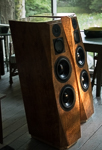
Here are the latest speakers I built for a friend's wedding gift. I used Seas Excel W15CY001 mids and T25CF001 Tweeters (new versions). The crossover was designed by someone who is well known, but it's not a public design so I can't divulge any info on it.
A few things to note about this build:
1. I will never use MDF again to build speakers. The stuff is brittle and I am too clumsy to use it without damaging edges and corners.
2. The size of the enclosure is .5 ft3, tuned to 45 hz. The ports are removable as the hole is snug enough to hold them in place, so I'll probably send a few extra ports, tuned to various frequencies, just in case. They are made for a small apartment, with neighbors being a concern, so output was not a primary concern.
3. I went with floorstanding because my friends are artists and artists usually like to put their speakers where they look nice, not where they sound nice. So, this was my devious little plan to get them to not position them on their sides under a couch.
4. The bottom wood piece is removable to access the crossovers, if needed.
5. Building a box is so much easier than building an enclosure with curved sides. It too a few weeks rather than several months.
6. They look different because the budget didn't allow two matched sheets of walnut veneer, so I used the same sheet. They each have their own character I guess. It bothers my OCD a bit, but I can live with it.
7. They were finished with Danish Oil for a few coats and then I got tired of applying Danish Oil because the stuff takes forever to build up, so I switched to General Finishes' oil varnish.
8. If you are using the iron on method, make 100% sure the glue is absolutely dry before starting, or you might have an incident like I did where the veneer adhered where I didn't want it to. It would not come off...
Pics:
All cuts made

Clamps, wood, and glue

Nearly a box

Damage and unseen fury. There was a dropping issue.

Repair in progress. I rabbeted out the damage and replaced with good wood. Then I flush trimmed to size

A fifth side

Jump forward a few days and they're lined with sound absorbing material, the crossovers are mounted, and the wires have been run.

Clamping on the top part of the front baffle (in two parts because baffles cut to size appeared with my order).

Glue drying so that veneer can be ironed on. Back piece was already attached.

Veneer attached to one speaker.

And the other...

Bases made, attached, and first coat applied

Seven or so coats later, with steel wool and sanding in between.

Binding Posts.

Drivers attached.

95% done and brought inside for a listen


A few things to note about this build:
1. I will never use MDF again to build speakers. The stuff is brittle and I am too clumsy to use it without damaging edges and corners.
2. The size of the enclosure is .5 ft3, tuned to 45 hz. The ports are removable as the hole is snug enough to hold them in place, so I'll probably send a few extra ports, tuned to various frequencies, just in case. They are made for a small apartment, with neighbors being a concern, so output was not a primary concern.
3. I went with floorstanding because my friends are artists and artists usually like to put their speakers where they look nice, not where they sound nice. So, this was my devious little plan to get them to not position them on their sides under a couch.
4. The bottom wood piece is removable to access the crossovers, if needed.
5. Building a box is so much easier than building an enclosure with curved sides. It too a few weeks rather than several months.
6. They look different because the budget didn't allow two matched sheets of walnut veneer, so I used the same sheet. They each have their own character I guess. It bothers my OCD a bit, but I can live with it.
7. They were finished with Danish Oil for a few coats and then I got tired of applying Danish Oil because the stuff takes forever to build up, so I switched to General Finishes' oil varnish.
8. If you are using the iron on method, make 100% sure the glue is absolutely dry before starting, or you might have an incident like I did where the veneer adhered where I didn't want it to. It would not come off...
Pics:
All cuts made
Clamps, wood, and glue
Nearly a box
Damage and unseen fury. There was a dropping issue.
Repair in progress. I rabbeted out the damage and replaced with good wood. Then I flush trimmed to size
A fifth side
Jump forward a few days and they're lined with sound absorbing material, the crossovers are mounted, and the wires have been run.
Clamping on the top part of the front baffle (in two parts because baffles cut to size appeared with my order).
Glue drying so that veneer can be ironed on. Back piece was already attached.
Veneer attached to one speaker.
And the other...
Bases made, attached, and first coat applied
Seven or so coats later, with steel wool and sanding in between.
Binding Posts.
Drivers attached.
95% done and brought inside for a listen






















Comment