

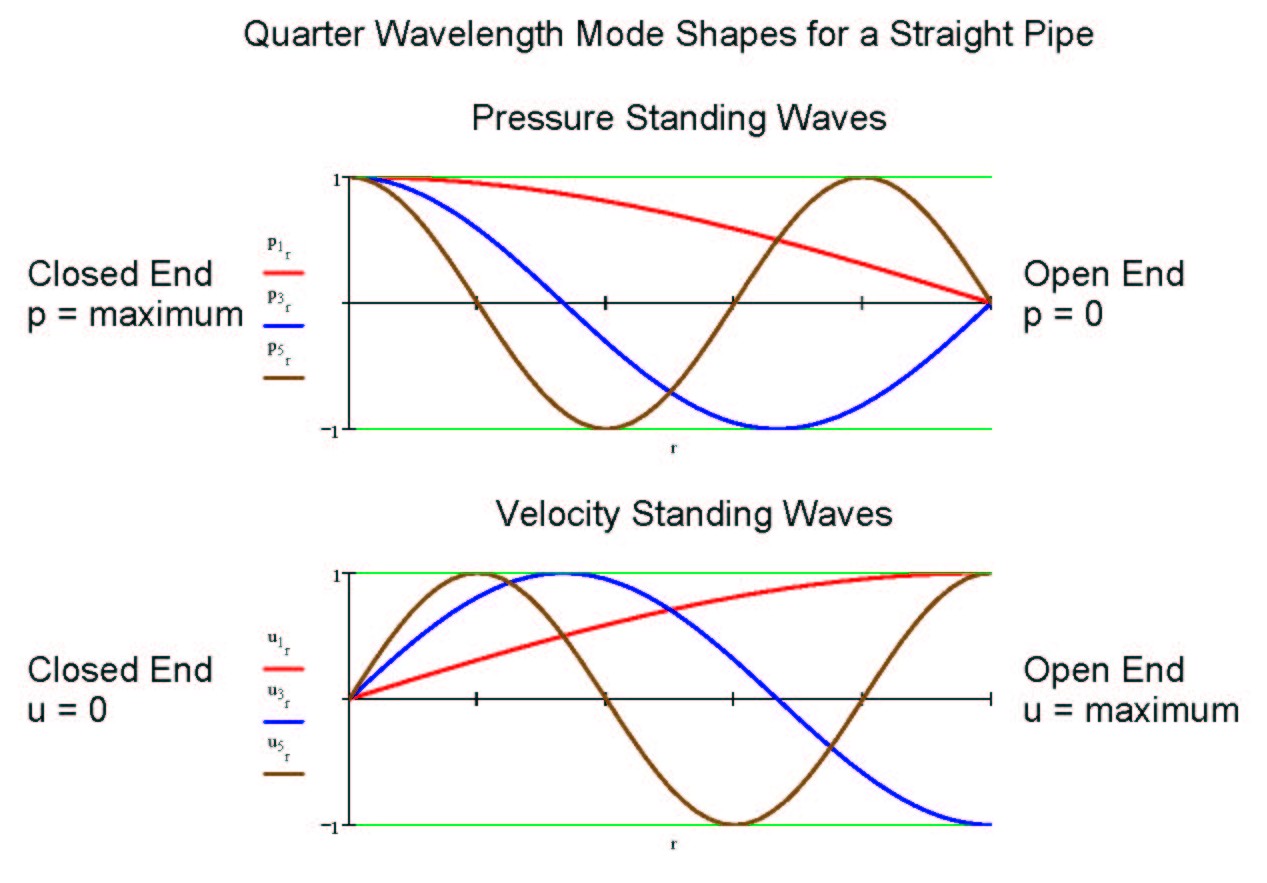
Started reading about transmission lines today and found this excellent reference. It sounds like, to find the ideal tuning, you need to balance the 1/4 wavelength resonance, fully stuffed, against the sealed box resonance, fully stuffed. I spent some time fiddling around, to see if I can come up with an ideal transmission line, and would like a sanity check to make sure I'm doing this right.
The 5" Scan-Speak Revelator has an Sd of 95cm^2, or .102 ft^2. According to the reference, the line's area should be slightly higher than that, so I figured I'd use .11 ft^2 (is this ok?). Balancing out the resonances, I came to a 1/4 wavelength that's just short of 120hz, so probably not a *great* driver choice, but this is for exploring transmission lines and the theories. Here's the math, for the sanity check.
Sd = .102 ft^2
Area = .11 ft^2
Freq = 120 hz
1/4 wavelength = 2.344425 ft
Line volume = 0.3481471125 ft^3 = 2.344425 ft * .11 ft^2 * 1.35 (stuffing)
Sealed box resonance in WinISD Pro = 62.49 hz
Stuffed line resonance = 60 hz = 120 hz * 0.5 (stuffing)
The stuffing multipliers are taken from the reference site. The sealed box resonance and the stuffed transmission line resonance are pretty close. So the ideal modeled transmission line would be just around the 1/4 wavelength of 120 hz, maybe a bit longer. So... did I do this right?
What kind of room extension would this give me? The effective tuning is 60 hz, and with the 6db/octave roll-off and room gain, that would be an F3 of about 35 hz? Or even lower?
Also, to find the maximum modeled power before bottoming out, would it be the amount of power where max excursion is reached in the sealed box at the stuffed line resonance (60 hz)? This is 60 watts, according to WinISD Pro.
I've attached my WinISD Pro project file. If anyone wants the file for the driver, let me know. The file is labeled as .txt, so change the extension to .wpr after downloading it.
The 5" Scan-Speak Revelator has an Sd of 95cm^2, or .102 ft^2. According to the reference, the line's area should be slightly higher than that, so I figured I'd use .11 ft^2 (is this ok?). Balancing out the resonances, I came to a 1/4 wavelength that's just short of 120hz, so probably not a *great* driver choice, but this is for exploring transmission lines and the theories. Here's the math, for the sanity check.
Sd = .102 ft^2
Area = .11 ft^2
Freq = 120 hz
1/4 wavelength = 2.344425 ft
Line volume = 0.3481471125 ft^3 = 2.344425 ft * .11 ft^2 * 1.35 (stuffing)
Sealed box resonance in WinISD Pro = 62.49 hz
Stuffed line resonance = 60 hz = 120 hz * 0.5 (stuffing)
The stuffing multipliers are taken from the reference site. The sealed box resonance and the stuffed transmission line resonance are pretty close. So the ideal modeled transmission line would be just around the 1/4 wavelength of 120 hz, maybe a bit longer. So... did I do this right?
What kind of room extension would this give me? The effective tuning is 60 hz, and with the 6db/octave roll-off and room gain, that would be an F3 of about 35 hz? Or even lower?
Also, to find the maximum modeled power before bottoming out, would it be the amount of power where max excursion is reached in the sealed box at the stuffed line resonance (60 hz)? This is 60 watts, according to WinISD Pro.
I've attached my WinISD Pro project file. If anyone wants the file for the driver, let me know. The file is labeled as .txt, so change the extension to .wpr after downloading it.



Comment