View Single Post
Old 03-02-2006, 09:48 PM   #70 ()
JonMarsh
Moderator
 
JonMarsh's Avatar
 
Join Date: Aug 2000
Location: Livermore, CA., USA
Posts: 7,459
Send a message via Yahoo to JonMarsh
Another crossover for the Milestone

Marc Heijligers new data has been plugged into LspCAD, and I put my thinking cap on carefully, hopefully straight enough..

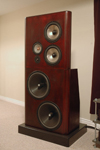
Marc's speakers are pretty much Klones of the Opus Ceramique- same drivers all aroundl


This crossover voicing is partly based on published reviews of the Eidelon, (which uses an Eton 11-581 11" woofer, not the 8" Accuton C220 woofer used in the Ceramique) privately measured data of an Eidelon, and a dash of my own common sense and inspired lunacy. Well, maybe not all that inspired.

Nominal crossover points in the Eidelon are 300 Hz and 2.5 kHz (some would call it 3 kHz, but with the amount of driver overlap, it's open to interpretation).

However, the crossovers are not truly symmetric on the low end; as is done by some practitioners (self included) the wooer uses an initially lower slope, partly as phase compensation for the acoustic offset, then steepening to an ultimate slope somewhat beyond the initial roll off point. Also, Avalon didn't really make much effort to deal with some of the diffraction boundary effects in the upper range of the 11-581. Also, the 11-581 doesn't quite have the Q of the upper break up peak that the C220 exhibits.

Additionally, the C79-6 is rolling off in the low end near the crossover point, so this has to be taken into account in realizing the target transfer function.

So, the target acoustical response was a slightly modified 2nd order all pass at about 275 Hz, and a 3rd order all pass at roughly 3 kHz. (shades of Natlie P). The cabinet diffraction complicates things a bit in the tweeter response, and that's part of why Avalon uses a pretty serious felt diffraction control structure built into the grille, and doesn't recommend playing the speakers without the grilles.

Here's the first pass on the crossover. Usually this is where I'd give my usual disclaimers about not having measured it yet, and the values aren't finalized. Well, I can't measure it myself, but maybe if Marc likes it he can build and measure and we can tweak as needed from there.


The low pass for the woofer is pretty straight forward, but as implemented it looks more like a 3rd order network, doesn't it? Well, the driver has rising response in this region on the baffle, so we need a bit extra filtering, and of course I wanted to put in a trap network, too, so L2 does double duty with C3 to implement the trap for the C220's breakup mode. C2 and R1 are just an inductive rise impedance stabilization network.


The midrange crossover is a bit more complicated (aren't they always?). Five components are just for the impedance zobel- R5, C8, and L6 compensate for the LF resonance rise, and C6 and R2 for the inductive rise. L6 can be an air core with skinny wire, and it's excess resistance subtracted from the value of R5.

R4 is for a little additional impedance stabilization, and if a resistor is conencted between it and C9, we'll have an LPad which might be needed if the midrange winds up needing to be padded down. According to LspCAD, it doesn't, but I don't completely trust that, I'll explain when we look at the transfer function plot.

C4 and L3, in combination with the driver roll off in the sealed enclosure, form the high pass network. L4, C7, and L5 realize the LP network for the midrange, and a certain amount of shelving in the upper portion of it's range.


The tweeter network looks like another bandpass nework, only because it is. C10, L7, and C11 form the high pass network, the transfer function looks a little odd because of teh acoutical response of the tweeter on the cabinet.

L9 and C12 form a roughly 2nd order Bessel low pass network, to filter supersonic components somewhat from exciting the tweeter resonance (tame as it is, ~ 6dB at 35 kHz). Avalon and VMPS are the only companies I know that have this kind of netwrork in most of their speakers. R6 and R7 are the level Lpad, and things came nicely together without any zobels on the tweeter, so I didn't put any in (collective gasp from the audience who knows my past crossover designs).


Here's the crossover transfer function, as modelled by LspCAD (that 6.20 version has a number of nice little tweaks - good going, Ingemar! )


Probably not what you expected.


Here's the predicted response, using Marc's new data:


Note that I did take some care about the phase and overlap characteristics in the crossover region, and reversing the midrange produces large nulls at both the woofer to midrange crossover and midrange to tweeter crossover. I took some care that the transistion regions were managed in good phase, considering driver physical locations, as are the Avalons. This LspCAD graph is assuming a seated position on axis with the midrange.

One thing I often see and that still puzzles me with relatively low frequency crossovers for a woofer is the interaction with the woofer and some peaking above the nominal bandpass level- you can see it in the predicted transfer function. I don't know how real that is, i.e., if LspCAD is correct, and it's one of those things I check carefully with the physical crosover. If LspCAD is not correct in predicting the network and driver response, we coudl be needing to reduce the midrange and tweeter level another couple of dB. I just don't know, unless Marc wants to fly the cabinets out here (way difficult), or I fly to the Netherlands (less difficult, still expensive).


Last, the predicted impedance curve- definitly not for SET amplifiers, will need a decent solid state amp. Where the impedance in the midbass is low, the phase shift is mostly fairly benign. My Aragons would be happy with this, but an HT receiver probably wouldn't.


Between six ohm drivers and crossover network interactions, it's pretty hard to keep the impedance much above 4 ohms. These speakers, like the Avalon's themselves, will like a high current solid state amp best.


On components, construction, and listening...


These are very high quality driver units, and to realize their performance will require similar construction components in the crossover.

For my own M8ta, I used NorthCreek AWG 12 coils in critical postions- both series coils on woofer, and the primary shunt coil on tweeter. Low DCR is quite important in those positions. Capacitors are all Solen metalized film, EXCEPT the series tweeter capacitors, which are half and half Solen and AudioCAP Theta Film and Foil. In this crossover L3 will be a bit of a bear, one might be tempted to use a ferrite core or laminated core inductor - DON'T!! Ultimate DCR is not that critical for the midrange high pass, but linearity at low frequencies is. The crossover should be assembled in an external box with good component spacing- look at my Arvo Pärt crossover boards, they can be a bit smaller, but don't crowd things. Actually, Avalon these days kind of cheese out in the crossover component build quality compared to when Charles Hansen was there. If one uses sand cast resistors, they should be the non-inductive type- 20 watt typical.


For wiring, either Cardas Hookup wire or Cardas Crosslink cable. The latter doesn't have to be twisted or bundled for runs to drivers. What I usually use is Crosslink to the mid and woofers, doubling up the conductors, (there's four in each cable, two per polarity), then a braided low inductance cable (like Kimber 4TC) for the tweeter. Using Cardas braided speaker wire would be prohibitively expensive, IMO. It's bad enough to have to use that to connect to the amplifiers!!


Last, to get the best out of an Avalon design speaker, they MUST be placed out from the boundaries; the Cardas setup guides are good, and what Avalon uses as a starting point. One will always have a lumpy bass and lower mids, and poor imaging if that isn't done. Look at the difference between these two response profiles, due to boundary loading of the floor, back wall, and adjacent side wall, and you'll understand.

Bad Positioning calculation Example:


Better Positioning calculation Example:


Marc has put a tremendous amount of effort and care into his speakers, and I hope that he gets them to realize their full potential someday soon! With the determination and effort he's shown with this endeavor, I'm sure it's just a question of time.

Best regards,

Jon
__________________
the AudioWorx
_______________________________

Modula MT
M8ta
Modula Neo D CC
Ardent
Modula MT MkII

coming in 2010....

Modula MTWW
Modula TMWW Xtreme
Ardent CCX (Compact Center Xtreme)
Ardent Cxi (tower, updated design)
JonMarsh is offline   Reply With Quote Reply